

What Is a Flange Butterfly Valve
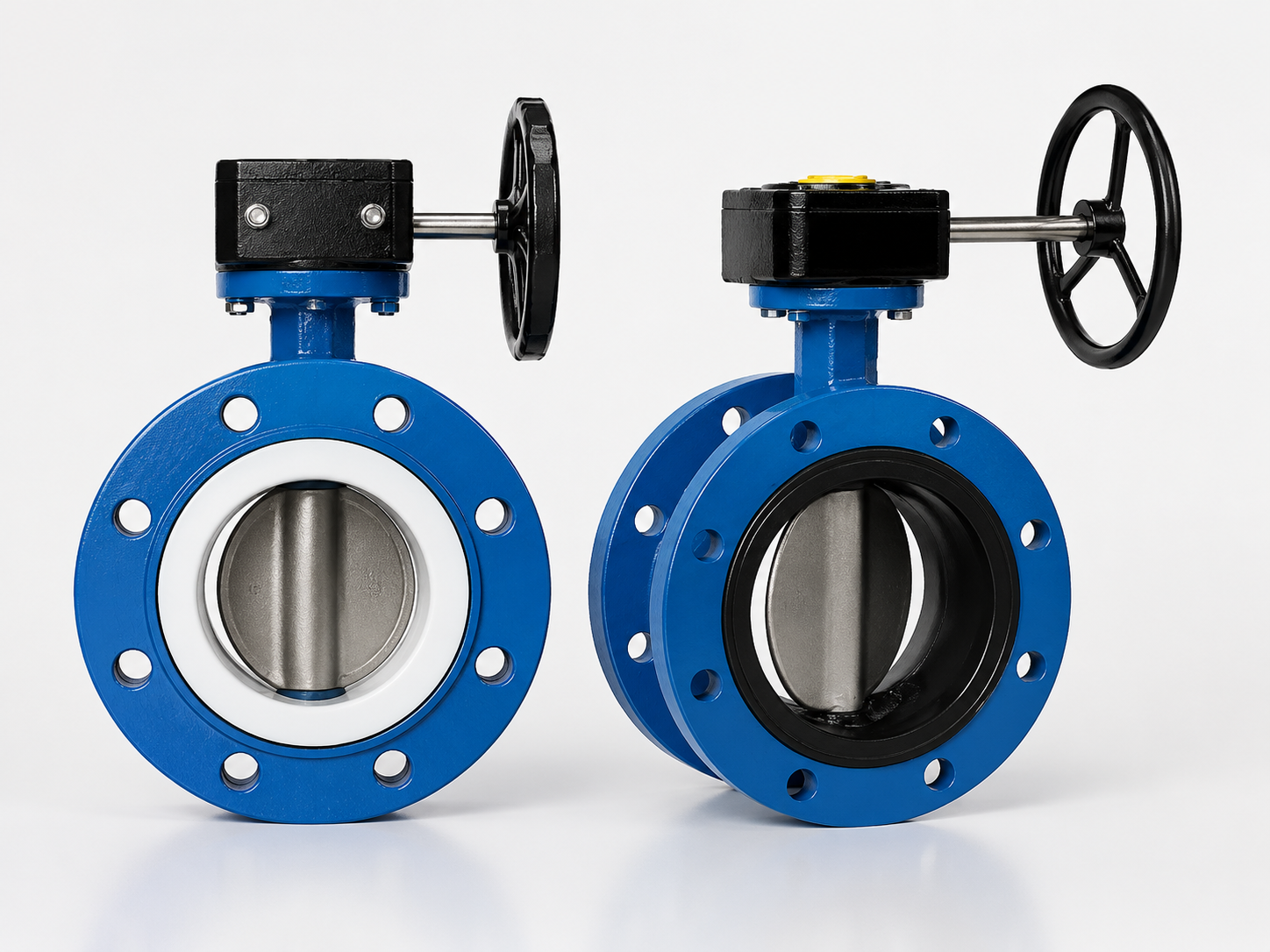
A flange butterfly valve is a quarter-turn valve with flanged ends that bolt directly to matching pipe flanges. A rotating disc inside opens or closes to control flow. Compared to wafer or lug designs, the flanged body gives a stronger, more secure connection for higher-pressure piping systems.
What Is a Flange Butterfly Valve and How Does It Work?
The valve works on a simple quarter-turn principle. A disc sits on a shaft inside the valve body. When the disc is parallel to the pipe, flow passes through. When it turns 90 degrees to sit across the pipe, flow stops.
What sets a flange butterfly valve apart from other butterfly valve types is the body itself. Instead of clamping between two pipe flanges (like a wafer valve) or bolting through threaded lugs (like a lug valve), a flanged body has its own integral flanges on both ends. Each side bolts independently to the matching pipe flange, using a separate bolt circle on each face.
This gives the valve its own structural strength, independent of the piping it connects to. It is one reason flanged designs are common in higher-pressure and larger-diameter services (ProjectMaterials, "Wafer vs Lug Butterfly Valve").
Main Components of a Flange Butterfly Valve
Body — Houses the flow passage and carries the integral flanges that bolt to the pipeline. The body also supports the stem bearings and seat.
Disc — The rotating element that opens or closes the flow path. Depending on where the stem meets the disc, valves are built as concentric (centered), double-eccentric, or triple-eccentric designs. Eccentric designs reduce seat wear because the disc lifts away from the seat as soon as it starts to rotate, rather than dragging across it.
Stem — Connects the actuator to the disc and transmits the turning force.
Seat — Creates the seal when the disc is closed. Seats are either soft (elastomer or PTFE, for lower temperature and general service) or metal (for higher temperature or abrasive media).
Actuator — The mechanism that turns the stem. This can be a manual lever, a handwheel with gearbox for larger valves, or a pneumatic or electric actuator for automated operation.
Flange Butterfly Valve vs. Wafer vs. Lug — What's the Real Difference?
All three are butterfly valve body styles covered under API 609, the standard for double-flanged, lug-type, and wafer-type butterfly valves. The difference is how the valve body connects to the pipeline, and that difference affects cost, strength, and serviceability.
| Feature | Wafer | Lug | Flanged |
|---|---|---|---|
| Connection method | Clamped between two pipe flanges by long through-bolts | Bolted to each flange separately through threaded lugs | Bolted to each flange separately through the valve's own integral flanges |
| Relative cost | Lowest | Moderate | Highest |
| Dead-end service | Not rated for it | Possible with threaded lugs, but check the manufacturer's pressure derating | Generally the most reliable option for dead-end service |
| Line break for maintenance | Requires shutting down both sides of the line | One side of the pipeline can often be removed without disturbing the other | Same as lug, with a stronger overall connection |
| Typical use case | Cost-sensitive, low-pressure lines with no dead-end requirement | Lines needing periodic single-side disconnection | Higher-pressure lines, larger diameters, or where a stable, permanent bolted connection matters |
Engineers on the Eng-Tips forum, an industry discussion board for piping and valve specification, generally agree with this pattern: a flanged valve is easier to mount and center and gives a mechanically stronger connection than a wafer valve, while wafer valves are chosen mainly to save cost when strength and dead-end capability are not required (Eng-Tips, "Butterfly Valves — Wafer Lugged or Flanged").
Flange Standards: ANSI, DIN, and JIS — Why They Matter
Before ordering a flange butterfly valve, the flange standard has to match the pipeline you're connecting to. Three standards dominate global trade:
ASME B16.5 (ANSI) defines pressure classes 150, 300, 400, 600, 900, 1500, and 2500. For carbon steel flanges, Class 150 is rated to about 285 psig (19.6 barg) at ambient temperature, while Class 300 is rated to about 740 psig (51.0 barg) at ambient temperature. Pressure ratings drop as temperature rises (ProjectMaterials, "Flange Class 150 vs 300").
EN 1092-1 (DIN) uses PN ratings such as PN10, PN16, and PN40. These are sometimes treated as rough equivalents to ASME classes, but they are not identical. EN PN16 is rated to about 16 barg (232 psig) at ambient, compared to about 19.6 barg (285 psig) for ASME Class 150. Bolt circles, bolt sizes, and raised-face heights also differ between the two systems (ProjectMaterials, "Class 150 vs PN16").
JIS B2220 is the Japanese standard, common across many Asian supply chains. It uses a "K" rating system — 5K, 10K, 16K, 20K, 30K, 40K, and 63K — where the number approximates the working pressure in kgf/cm². JIS 10K is roughly comparable to ASME Class 150, and JIS 20K is roughly comparable to Class 300, but dimensions, bolt circles, and bolt patterns are not interchangeable with ASME or DIN flanges (ProjectMaterials, "What Is JIS B2220?").
Mixing standards on the same joint is a common and costly specification error. Always confirm the flange standard, pressure class, and facing type your project requires before placing an order. Our flange product range and our flange buyer's guide cover this in more depth.
Is a Flange Butterfly Valve Safe for Dead-End Service?
Dead-end service means the valve closes off a pipeline while one side has no supporting flange behind it, such as at the end of a branch line. This is a genuine engineering concern, not just a specification detail.
Practicing engineers on the CR4/GlobalSpec forum note that a plain wafer valve is not built for this, since it relies on the pipe flanges on both sides to hold it in place. A lug-style valve can support dead-end service, but only if the lugs are threaded, and even then, manufacturers commonly apply a lower maximum pressure rating for dead-end use than for the valve's normal in-line rating (CR4/GlobalSpec, "Wafer vs Lug Type Butterfly Valve").
A flanged design, because each side bolts independently into its own integral flange, generally gives the most dependable dead-end performance of the three body types. Even so, always confirm the manufacturer's specific dead-end pressure rating rather than assuming the standard in-line rating applies. One engineer on the same forum summed up the caution plainly: a blind flange is still recommended at any true line end, regardless of valve type.
Fire-Safe Considerations for Flange Butterfly Valves
In hydrocarbon, chemical, or other high-risk services, fire performance is a real safety factor, not a marketing checkbox.
API 607 (harmonized with ISO 10497 and BS 6755 Part 2) is the standard fire test for quarter-turn valves, including butterfly valves. It requires the valve to be exposed to a direct flame of roughly 750–1000°C for 30 minutes, then checked for allowable seat and body leakage both during and after the fire, and confirmed to still open and close afterward (ProjectMaterials, "What Is Fire Safe Valve?"). Fire-safe qualified valves typically use a secondary metal seal behind the primary soft seat, so if the soft seat burns away, the metal seal still limits leakage.
This connects directly to body-style choice. Engineers caution against using wafer-style valves in hydrocarbon or toxic service, because the long through-bolts that hold a wafer valve in place can expand and loosen under fire conditions, which can feed rather than contain a fire (Eng-Tips, "Butterfly Valves — Wafer Lugged or Flanged"). A flanged or lug body, bolted independently on each side, does not share this specific failure mode. If your project specification calls for fire-safe valves, confirm the valve carries a current API 607 or ISO 10497 test certificate for its specific size and pressure class, since fire testing qualifies a design family rather than every individual unit.
Common Applications of Flange Butterfly Valves
Flange butterfly valves are widely specified in water and wastewater treatment, oil and gas processing, power generation cooling water systems, chemical processing, and HVAC systems. They are especially common wherever a project calls for larger pipe diameters, higher pressure classes, or a bolted connection that will remain undisturbed for long service periods.
What to Look For When Buying a Flange Butterfly Valve
Confirm these details before ordering: the required flange standard and pressure class (ASME, DIN, or JIS, and the exact class or PN/K rating), the disc type (concentric, double-eccentric, or triple-eccentric, based on your pressure and cycle-life needs), the seat material suited to your media and temperature, whether dead-end service is required and at what pressure, whether a fire-safe certification is required for your application, and the actuation method (manual, gear, pneumatic, or electric). Browse our industrial valve range or see our industrial valves guide for a broader comparison across valve types.
FAQs
What is the difference between a wafer and a flange butterfly valve?
A wafer valve clamps between two pipe flanges using long through-bolts and has no flanges of its own. A flange butterfly valve has its own integral flanges on each end and bolts independently to each pipe flange, giving a stronger, more stable connection.
Can a flange butterfly valve be used for dead-end service?
Generally yes, and it is typically the most reliable body style for this among the three common types. Even so, always check the manufacturer's specific dead-end pressure rating, since it is often lower than the valve's standard in-line rating.
What is the difference between raised face and flat face flanges?
A raised face flange has a small raised ring around the bore that concentrates gasket compression into a smaller area, common in ASME Class 150 and higher applications. A flat face flange has no raised ring and distributes gasket load over the full face, which is typically used when mating to cast iron or other flanges that cannot handle the concentrated stress of a raised face. Mismatching the two without an appropriate gasket can cause sealing problems, an issue engineers still actively discuss for lugged valve designs (Eng-Tips, "Raised Face vs Flat Face Lugged Valves").
What flange standards do flange butterfly valves come in?
The three most common are ASME B16.5 (ANSI, Class 150 through 2500), EN 1092-1 (DIN, PN ratings), and JIS B2220 (K ratings). These are not dimensionally interchangeable, so the standard must match your pipeline flanges exactly.
Is a flange butterfly valve more expensive than a wafer valve?
Yes, typically. The valve's own integral flanges and heavier body use more material and machining than a wafer design. The added cost is generally justified when dead-end service, higher pressure, or a more permanent bolted connection is required.
Are flange butterfly valves fire-safe?
Not automatically. Fire safety depends on the specific seat and seal design, not the body style alone. A flange butterfly valve can be built and certified to API 607 or ISO 10497 if it uses a fire-safe seat design with a secondary metal seal, but this must be confirmed with a current test certificate for the exact model, size, and pressure class you are ordering.
What pressure rating can a flange butterfly valve handle?
This depends entirely on the flange standard and class specified, not on the fact that it is a "flange" valve. For example, an ASME Class 150 flanged valve is rated to about 285 psig at ambient temperature, while a Class 300 valve is rated to about 740 psig at ambient. Always check the manufacturer's pressure-temperature rating table for your specific size and material, since ratings drop as operating temperature rises.
Bottom Line
A flange butterfly valve gives you a quarter-turn shutoff with its own bolted, flanged connection on each side, making it the strongest and generally most dead-end-reliable of the three common butterfly valve body styles. The right choice still depends on matching the flange standard, pressure class, seat material, and fire-safety requirements to your actual piping system, not on the body style alone. When in doubt, confirm the exact rating and test certification with your supplier before specifying.