

Platinum vs. Tantalum for Severe Acid Processing
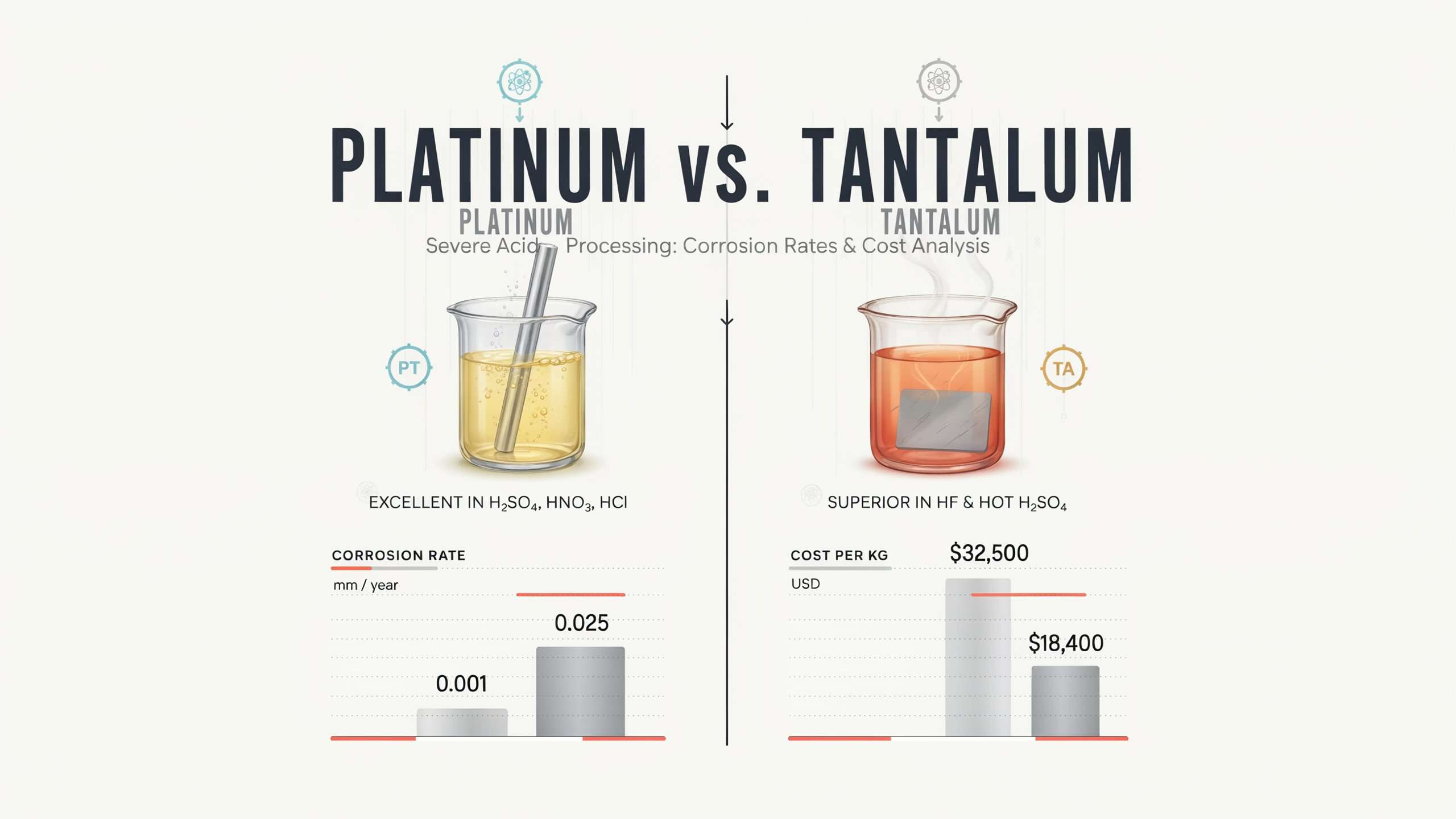
Tantalum is the better choice for most hot hydrochloric and sulfuric acid service, and it costs roughly 60 to 110 times less than platinum per unit volume at November 2026 prices. Platinum tolerates fluoride, which tantalum cannot, but it dissolves in aqua regia and has a poor record in hot concentrated sulfuric acid. This guide to platinum vs. tantalum for severe acid processing gives corrosion rates with their test conditions, separates laboratory data from plant experience, and prices both metals per square meter of lining instead of per kilogram.
Short answer: which metal for which acid
Neither metal wins everywhere. The deciding factors are fluoride, oxidizing chloride, and the metal-surface temperature.
|
Service condition |
Better fit |
Reason |
Evidence |
|---|---|---|---|
|
HCl, up to about 150 °C |
Tantalum |
Reported rates below 0.025 mm/yr; platinum adds cost without benefit |
Distributor table |
|
HCl, 190-250 °C |
Tantalum-tungsten alloy, ideally platinum-modified |
Oxide film can degrade; hydrogen uptake becomes the main risk |
Lab (patents, trade journal) |
|
H2SO4, up to about 150 °C |
Tantalum |
Low rates across concentrations |
Distributor and fabricator claims |
|
H2SO4, 150-200 °C |
Tantalum, only with coupon and hydrogen testing |
Sources disagree on the ceiling |
Conflicting |
|
H2SO4 above about 200 °C, including boiling 98% |
Neither is proven |
Tantalum corrodes and absorbs hydrogen; platinum stills were destroyed rapidly in an 1890 patent's account |
Lab and historical |
|
Oleum (free SO3) above about 150 °C |
Neither is proven |
Tantalum is attacked; I found no platinum data |
Gap |
|
HF or fluoride present |
Platinum, or a nickel-copper alloy |
Tantalum is attacked rapidly |
Qualitative |
|
Aqua regia, Cl2 with HCl |
Tantalum |
Platinum dissolves as chloroplatinic acid |
Chemistry, secondary sources |
|
Hot concentrated phosphoric acid |
Neither |
Tantalum rate is high at 250 °C; platinum dissolves under anodic current |
Vendor-grade and lab |
The evidence column matters. Most tantalum numbers come from distributors and patents, and I found no authoritative corrosion-rate table for platinum in any of these acids.
Why the two metals fail in different places
Tantalum is protected by a film. It forms a thin tantalum pentoxide (Ta2O5) layer that re-forms when scratched. Corrosion rates stay low as long as the film stays intact. Three things break it: fluoride, temperatures in roughly the 190-250 °C range for hot HCl and H2SO4 (per ATI's work), and strong alkali.
Platinum is protected by nobility. It does not oxidize in non-oxidizing acids, so it needs no film. It fails when an oxidizer and a chloride complexing agent act together. Chlorine from aqua regia, or from Cl2 bubbled into hot concentrated HCl, converts platinum to soluble hexachloroplatinic acid (H2PtCl6). Refiners use exactly that reaction to dissolve it.
This explains the pattern in the rest of the guide. Tantalum is strong in hot chloride and sulfate acids, including oxidizing chloride, and weak in fluoride and alkali. Platinum tolerates fluoride and is weak in oxidizing chloride.
Corrosion rates by acid, with test conditions
Treat every number below as valid only for its stated conditions. The rates come from different kinds of sources, so the last column says which.
|
Acid and conditions |
Tantalum |
Platinum |
Source type |
|---|---|---|---|
|
HCl, 37% or below, up to boiling at atmospheric pressure |
Below 0.025 mm/yr (1 mpy) |
Labware rated resistant to HCl; no rate found; attacked if Cl2 or HNO3 is present |
Distributor table; supplier rating |
|
30% HCl, 220 °C, 15 weeks, Ta-3W alloy |
Rate described as already low; platinum additions cut it up to 3x; about 7 mpy (0.18 mm/yr) at 250 °C with platinum |
Not tested |
Trade journal (AMPP, ATI work) |
|
HCl, ATI short-term tests, baseline Ta-3W (NRC76) |
About 16 mpy (0.41 mm/yr); under 4 mpy (0.10 mm/yr) with at least 1,000 ppm Pt |
Not tested |
Patent; exact conditions are in its figures |
|
H2SO4, up to 98%, up to 200 °C |
Below 0.025 mm/yr in one table, though the same page gives 150 °C as the maximum service temperature in acids |
No rate found; historical stills lost metal rapidly at 80-98% |
Distributor; 1890 patent |
|
100% H2SO4, one-year exposure |
0.0004 mm/yr at 175 °C; 0.006 mm/yr at 200 °C |
No data |
Secondary article, original test unverified |
|
H2SO4, ATI long-term tests, baseline Ta-3W |
About 9.2 mpy (0.23 mm/yr); under 4 mpy with at least 1,500 ppm Pt |
Not tested |
Patent |
|
H2SO4, boiling 98% (roughly 330 °C) |
Rated poor |
Not tested; gold and SiC rated excellent in the same study |
Laboratory (Korean nuclear-hydrogen study) |
|
Oleum, 15% SO3, 130 °C |
15.6 mm/yr reported |
No data |
Secondary article, unsourced |
|
H3PO4, 85%, up to 150 °C / at 250 °C |
Below 0.025 mm/yr / about 20 mm/yr |
0.91 mg/cm²/h at 1 A/cm² and 40 °C under anodic polarization |
Distributor / secondary article; fuel-cell electrochemistry |
|
Aqua regia |
Reported inert |
Dissolves |
Secondary sources; refining chemistry |
|
HF |
Rapid attack |
Used in dilute HF cleaning of platinumware; no rate found |
Distributor; lab-ware guidance |
The platinum phosphoric figure is an electrochemical result, not an immersion rate. It shows that potential can drive dissolution, not what a vessel would lose.
Laboratory results are not plant results
The ATI and Korean numbers come from coupons immersed for weeks to months. A plant differs in four ways that coupons do not capture:
- Heat-transfer surfaces run hotter than the bulk acid, so the wall temperature can exceed the limit you designed to.
- Crevices under flanges, gaskets and liner edges can see different chemistry than the bulk.
- Flow, solids and start-up transients differ from a quiet beaker.
- Impurities, including oxidizers and fluoride at trace level, change which side of the film's stability limit you are on.
Case history supports the caution. Alfa Laval reports that for a thin tantalum layer over a base metal, an uncovered spot of 1 mm² can corrode a heat exchanger in hours. ASM's failure-analysis collection lists a steam-heated tantalum exchanger for concentrating sulfuric acid that passed shop inspection and leaked during site testing; the excerpt I saw did not state the cause.
Why a "low" rate still matters for thin liners
Typical tantalum liners are thin, about 0.76 mm (0.030 in) in one fabricator's patent. Conversions use 1 mpy = 0.0254 mm/yr.
|
Corrosion rate |
mm/yr |
Years to consume a 0.76 mm liner (uniform loss only) |
|---|---|---|
|
1 mpy |
0.025 |
about 30 |
|
4 mpy |
0.10 |
about 7.5 |
|
7 mpy |
0.18 |
about 4.3 |
|
16 mpy |
0.41 |
about 1.9 |
These are upper-bound lives. Hydrogen embrittlement can end a liner's life before wall loss does.
Where tantalum fails
Hydrogen embrittlement, not wall loss
In very hot, concentrated HCl and H2SO4, hydrogen embrittlement is the main failure mode for tantalum, according to ATI's patents and a trade-journal article on its alloy work. Corrosion releases atomic hydrogen at the surface. Tantalum absorbs it, and the metal becomes brittle above about 100 ppm hydrogen.
A liner can therefore lose almost no thickness and still crack. Measuring corrosion rate alone will miss this. Coupon programs for hot service should include hydrogen analysis of the exposed metal.
Three temperature ceilings, and what they mean
Sources quote different limits, and they describe different things:
- 150 °C: a conservative design limit for acids, given by a distributor and by Alfa Laval.
- About 200 °C: where a JGC patent says hot concentrated sulfuric acid starts to cause considerable corrosion and hydrogen absorption.
- 190-250 °C: the window in which ATI says the Ta2O5 film can degrade, depending on the process environment.
My reading: design to 150 °C for unmonitored service. Between 150 and 200 °C, require coupon and hydrogen data for your actual stream. Above 200 °C, expect measurable attack and hydrogen pickup. This is an interpretation of the sources, not a published rule.
Oxidizer content can shift the result. The JGC patent reports that adding concentrated nitric acid roughly halved tantalum's corrosion rate in 91% H2SO4 at 260 °C. The patent addresses service above 200 °C.
Fluoride, oleum and alkali
HF and fluoride-bearing solutions attack tantalum rapidly. One distributor lists Monel 400 as the usual alternative for HF. Above about 150 °C, fuming sulfuric acid (free SO3) also attacks tantalum, and a fabricator-linked page puts the limit at acid stronger than 98%. Strong alkali is another exclusion: a distributor lists attack above 10% concentration and 50 °C.
Pinholes and joints
Because tantalum is usually a thin layer over steel, a defect exposes the base metal. Alfa Laval's 1 mm² warning applies here. Tantalum's high melting point also makes fusion welding to steel impractical, so liners are loose-fitted, mechanically attached or clad. Fabricators also have to allow for different thermal expansion between liner and shell, which one patent solves with convoluted liner sections that act like bellows.
Where platinum fails
Some supplier pages state that no acid attacks platinum. Aqua regia and oxidizing chloride prove otherwise, and the evidence below shows further limits.
Oxidizing chloride
Aqua regia dissolves platinum. So does concentrated HCl with chlorine gas: a refining patent describes a leach of platinum-group metals in concentrated HCl with Cl2 at 80 °C. Any process stream that combines chloride with free chlorine, nitric acid or another strong oxidizer is a risk for platinum. It is a strength for tantalum.
Hot concentrated sulfuric acid
Platinum was the historical material for sulfuric acid concentration. Nineteenth-century patents describe platinum stills and retorts, and one 1875 patent says they were used because strong acid destroyed base metals. A later patent, from 1890, says platinum stills used at 80-98% acid were rapidly destroyed with considerable loss.
That is qualitative and over a century old. I found no modern rate table. It does show that platinum was a costly consumable in this service, not a permanent one. Modern research has used platinum-lined tubular reactors for sulfuric acid decomposition under pressure (a 2007 AIChE conference paper from KIST), which suggests continuing interest but gives no rate.
Phosphoric acid under potential
In fuel-cell research, platinum dissolved at 0.91 mg/cm²/h in 85% phosphoric acid at 1 A/cm² and 40 °C, about 180 times faster than in 1 M sulfuric acid under the same conditions. This applies to anodes, not idle vessels, but it is a warning for any platinum electrode or electrically coupled part in phosphoric acid.
Contamination and embrittlement
Heraeus lists carbon, silicon, lead and iron among the elements that damage platinum equipment, and notes that platinum picks up hydrogen at 400 °C. Most of these effects occur at high temperature, in furnaces and fusions, so they matter less in wet acid service than in calcination or digestion steps. They still matter for repairs and for contact with iron-bearing tools and scale.
The hybrid option: platinum inside tantalum
The most useful finding for buyers is that platinum is often not an alternative to tantalum but an additive to it. Three lines of work show this.
Platinum-modified tantalum-tungsten alloy (ATI). Alloying small amounts of platinum into Ta-3W improved both corrosion and hydrogen resistance in the lab. The best range was about 1,000-3,000 ppm Pt, which means platinum is a few parts in a thousand of the alloy by weight, not a cladding layer. ATI's patent figures show hydrogen pickup falling from 756 ppm to under 10 ppm in long-term HCl tests, and from 9 ppm to under 2 ppm in H2SO4. In 30% HCl at 220 °C for 15 weeks, hydrogen enrichment fell by more than 100 times. ATI proposes that platinum creates low-hydrogen-overvoltage sites that shift the surface potential in the noble direction. That mechanism is a theory, not a proven result.
Platinum spotting and implantation. Earlier work found that platinum spots helped pure tantalum but gave almost no benefit on Ta-3W. A 2012 study implanted platinum into tantalum surfaces; untreated tantalum failed mechanical tests from embrittlement after a short time in hot mineral acids, while implanted samples lasted considerably longer.
Platinum-clad tantalum electrodes. Where platinum's electrochemical behavior is needed, a thin platinum surface on a tantalum core saves metal. An early Austrian patent describes platinum covering only part of a tantalum anode, and a later US patent describes diffusing a platinum layer into the tantalum surface.
A cheaper variant is also on record: the AMPP article reports that low levels of ruthenium gave similar improvement, and noted that ruthenium cost about a tenth as much as platinum when it was written.
Limits of this evidence. These are coupon tests and patents. I did not confirm that a platinum- or ruthenium-modified tantalum product is stocked by mills, and the evidence covers microalloying and thin surface treatments, not bolting platinum parts onto tantalum equipment. Ask suppliers for availability, lead time, and field references before specifying.
Mechanical properties, fabrication and maintenance
|
Property |
Tantalum |
Platinum |
|---|---|---|
|
Density |
16.65 g/cm³ |
21.45 g/cm³ (some pages print 21.09) |
|
Melting point |
2,996 °C |
About 1,770 °C |
|
Annealed strength (R05200) |
Yield 207 MPa, tensile 345 MPa, elongation at least 25% |
Soft; one supplier reports about 30% more strength from adding 5% gold |
|
Air oxidation |
Begins around 300 °C |
Stable in air at high temperature |
|
Alloy options |
Ta-2.5W (R05400), Ta-10W (R05252); the 2.5% W grade showed about twice the yield strength of unalloyed tantalum at 200 °C in one patent |
Pt-Au, Pt-Rh and others |
|
Typical form in acid service |
Thin liner or clad on steel (about 0.3-1.5 mm), bayonet heater tubes, small-bore piping |
Thin-walled stills, dishes and crucibles; research reactor liners |
|
Joining |
Inert-gas shielding is mandatory; fusion welding to steel is impractical |
Not covered by the sources I found for process equipment |
Two design consequences follow. Tantalum's strength is modest, so liners rely on the steel shell for structure. Platinum's softness and cost push designers toward thin walls, and a platinum vessel was historically valued partly because it could be made thin and transmit heat readily, according to an 1870s patent.
Inspection and maintenance
Tantalum equipment needs:
- Holiday or pinhole testing after fabrication and after any repair, because one defect can fail a thin liner.
- Coupon exposure and, for hot service, hydrogen analysis, since wall thickness alone will not show embrittlement.
- Controls that keep process temperature and fluoride content inside the design envelope.
Platinum equipment needs:
- Weighing before and after campaigns, so metal loss is measured instead of guessed. This is my recommendation, not a sourced practice.
- Keeping the metal away from iron, lead, carbon and silicon sources at high temperature.
- Cleaning by boiling in dilute HCl, as platinumware guidance describes, or by dilute HF soaking where fluoride cleaning is acceptable.
A field example shows why maintenance cost matters. Alfa Laval describes a specialty chemical plant that heated hot sulfuric acid with a 3 m graphite block exchanger, which had to be lifted out of position and repaired once a year. The plant replaced it with a 30 cm tantalum unit. That is a vendor account, but the right frame for lifecycle cost is the incumbent's annual repair against the replacement's maintenance record.
Cost analysis: price per square meter, not per kilogram
Price per kilogram misleads here, because platinum is 29% denser and the two metals are used at very different thicknesses. The better unit is metal value per square meter of surface. All arithmetic below is mine, using the stated prices and thicknesses.
Metal prices (raw metal, not fabricated equipment)
|
Metal |
Price |
Date |
Source |
|---|---|---|---|
|
Platinum |
$1,428.10/oz, or $45.91/g |
3 Nov 2026 |
|
|
Tantalum ingot, 99.95% |
$399/kg, then $921/kg |
16 Jan and 15 Jul 2026 |
SMM (excerpt) |
|
Tantalum, US average |
$546/kg |
Q2 2026 |
IMARC |
Per cm³, platinum costs about $985 and tantalum about $9-15, so platinum costs roughly 60-110 times more. Fabricated plate, tube and welded equipment cost more than ingot for both metals.
Metal value per square meter
|
Construction |
Metal mass |
Metal value |
|---|---|---|
|
Tantalum, 0.5 mm |
8.3 kg/m² |
$4,500-7,700 |
|
Tantalum, 1.0 mm |
16.7 kg/m² |
$9,100-15,300 |
|
Platinum, 0.1 mm |
2.15 kg/m² |
about $98,500 |
|
Platinum, 0.01 mm (10 µm) |
0.21 kg/m² |
about $9,800 |
A platinum layer would need to be only about 5-16 µm thick to match a 0.5-1.0 mm tantalum liner on metal cost. That thickness belongs to plating, cladding and coatings, not to a self-supporting liner. It is why platinum shows up as a surface or additive on tantalum rather than as a replacement.
What a corrosion rate costs in lost metal
|
Case |
Metal consumed per m² per year |
Value lost per m² per year |
|---|---|---|
|
Tantalum at 0.10 mm/yr (4 mpy) |
1.67 kg |
$910-1,530 |
|
Platinum at 0.01 mm/yr |
0.21 kg |
about $9,850 |
For platinum to lose metal as cheaply as tantalum at 0.10 mm/yr, it would have to corrode at about 1 µm/yr or slower. I found no platinum rate data to say whether it does in any given acid. This calculation ignores recovery of dissolved platinum, product contamination and downtime, all of which can dominate in practice.
Prices move, and the ratio moved with them
Platinum traded under $1,000/oz at the start of 2025, passed $2,300 on 7 January 2026 (Capital.com), and stood at $1,428 on 3 November. Tantalum ingot rose about 130% between January and July 2026 in SMM's assessments. Using mixed dates, the platinum-to-tantalum cost ratio per cm³ fell from about 240 in January to roughly 60-110 now.
A lifecycle comparison made last winter is wrong today in both directions. Re-run it with quote-date prices, and ask suppliers whether price is fixed or tied to the metal market.
Lifecycle cost: what to put in the model
Vendor claims point the same way but are not independent evidence. Titan Metal Fabricators says tantalum coils for HCl pickling are cost-competitive with PTFE immersion heaters. A trade-show listing for a tantalum heat exchanger claims lower total cost of ownership than high-grade alloys, graphite, silicon carbide or glass. Test those claims against your own figures:
- Installed cost of the lined or clad equipment, including skilled inert-atmosphere welding and pinhole testing.
- Expected life from your measured rate and hydrogen data, not from a catalog table.
- Planned inspection, repair and spare-part cost, compared with the incumbent material.
- Outage cost if a liner fails in service.
- End-of-life metal value and any refining terms. I did not find sourced figures for scrap recovery on either metal, so get these in writing.
Selection guide and industrial examples
Work through these questions in order. Each one removes an option before cost enters the discussion.
- Is fluoride present? HF or fluoride salts rule out tantalum. Consider platinum, a nickel-copper alloy, or a non-metal.
- Is free chlorine, nitric acid or another strong oxidizer present with chloride? That rules out platinum and favors tantalum.
- What is the metal-surface temperature, including heat-flux surfaces? Up to 150 °C, tantalum has the broadest support. From 150 to 200 °C, demand coupon and hydrogen data. Above 200 °C, no option in this guide is proven.
- Is the acid oleum or stronger than 98%? Tantalum is attacked above about 150 °C, and I found no platinum data. Ask a corrosion specialist before specifying either.
- Does the service need platinum's properties, or only its additive effect? If the goal is hydrogen protection in hot HCl or H2SO4, a platinum-modified tantalum alloy may do the job for a fraction of the cost, subject to availability.
- Price both options on quote-date metal prices and your measured rates. Use the per-square-meter and lifecycle tables above.
Alternatives worth checking first
|
Material |
Where it fits |
Caution |
|---|---|---|
|
Zirconium |
Hot HCl and moderate H2SO4 |
One fabricator-linked page says it loses resistance above about 75% H2SO4 |
|
Hastelloy C-276 |
HCl and sulfuric acid at lower temperatures; a distributor rates it "good" in 20% HCl at 80 °C and "moderate" in boiling 50% H2SO4 |
Sources conflict: one distributor rates it moderate in boiling 50% H2SO4, another reports rapid corrosion in 10-90% H2SO4 below 100 °C |
|
Nickel-copper (Monel 400) |
HF |
Verify against your stream's oxidizer content |
|
Gold and silicon carbide |
Boiling 98% H2SO4, where one lab study rated both excellent and tantalum poor |
Gold degraded when 0.5 M HI was added; limited industrial data here |
|
Graphite, PTFE, glass-lined steel |
Traditional choices for hot-acid heating and vessels |
Alfa Laval cites annual repairs on a graphite block exchanger |
Where each metal is used in practice
- Tantalum: bayonet heaters and heat exchangers for sulfuric acid reconcentration; HCl recovery and pickling-line heating; bromine production; plugs and patches in damaged glass-lined vessels.
- Platinum: historically, stills for concentrating sulfuric acid; today, laboratory crucibles and dishes, electrodes, and research reactors such as the KIST platinum-lined tubular reactor for sulfuric acid decomposition.
- Both: platinum-clad tantalum electrodes, which use each metal for what it does best.
Frequently asked questions
Does acid dissolve platinum?
Single acids such as HCl, H2SO4 and HNO3 generally do not at moderate conditions, and suppliers rate platinumware resistant to them. Aqua regia does dissolve it, as does concentrated HCl with chlorine. Historical platinum stills also lost metal in hot 80-98% sulfuric acid.
Is tantalum better than platinum for sulfuric acid?
On cost and on the available rate data, yes, up to about 150 °C and probably to 200 °C with testing. Above 200 °C tantalum absorbs hydrogen and corrodes, and no source I found proves platinum is a better answer there.
Why does tantalum crack when its corrosion rate is low?
Corrosion produces hydrogen at the surface. Tantalum absorbs it, and above about 100 ppm hydrogen the metal becomes brittle. Measure hydrogen in coupons, not only weight loss.
Can platinum and tantalum be combined?
Yes, in lab work and in electrodes. Small platinum additions to Ta-3W sharply cut hydrogen pickup in ATI's tests. Confirm commercial availability with the mill before specifying.
Which metal is cheaper?
Tantalum, by roughly 60-110 times per unit volume at November 2026 prices. The gap was far wider in January 2026, so price your own case on quote-date numbers.
Data notes and sources
Prices are as of 3 November 2026 unless dated otherwise. Corrosion data comes in three grades: distributor and vendor tables, patents and trade-journal articles, and lab studies. None is plant performance data. Where no data was found, such as platinum corrosion rates in HCl, H2SO4 and oleum, this guide says so. Before specifying equipment, test your own stream: coupons at the real wall temperature, with hydrogen analysis for tantalum.
Leave Your Comments
Recent Post