

Platinum Cladding vs. Electroplating
Platinum is chosen for its resistance to corrosion. The irony is that the method used to apply it — cladding or electroplating — determines whether that resistance holds over a service life or quietly accelerates the very failure it was meant to prevent.
Both processes put platinum onto a base metal. Both produce a functional platinum surface. But the bond they create, the structural integrity of the coating, and the consequences of any defect in that surface are fundamentally different. For engineers specifying platinum-coated components, or procurement teams sourcing them, understanding this distinction matters far more than most supplier literature acknowledges.
How Each Process Creates Its Bond
Platinum Cladding: Solid Metal, Metallurgical Contact
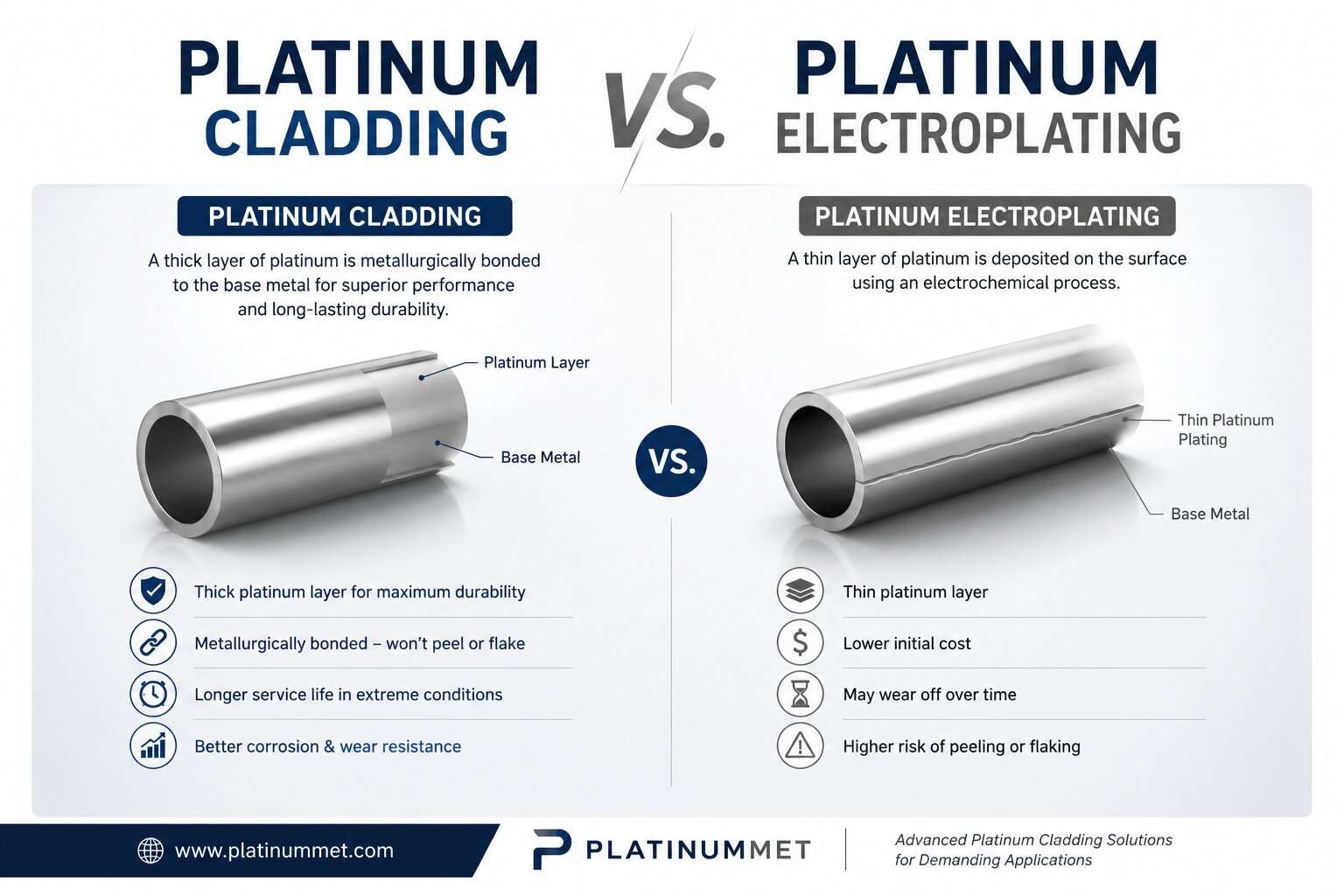
Cladding uses solid platinum foil — typically 25 to 250 µm thick — permanently bonded to a substrate (most commonly titanium, niobium, or tantalum) through a mechanical process that forces direct atomic contact between the two metals.
The three methods in industrial use each achieve this differently:
Roll bonding passes the platinum foil and substrate together through high-pressure rollers. Heat and pressure cause the metal surfaces to fuse metallurgically. Cold roll bonding uses surface preparation and annealing to stabilize the bond after rolling.
Explosive cladding accelerates a platinum foil into the substrate using a controlled explosive detonation. The high-velocity impact generates a pressure pulse at the interface that strips surface oxides and creates a wave-pattern metallurgical bond — the characteristic wavy interface that confirms complete bonding under microscopic inspection.
Hot isostatic pressing (HIP) uses simultaneous heat and isostatic pressure to achieve diffusion bonding across the entire interface. Gas pressure diffusion welding produces a similar result for complex geometries.
In all three cases, the output is the same: a metallurgical bond with no adhesive layer, no intermediate chemistry, and no electrochemical process. The platinum layer is not deposited — it is fused. The coating's density and integrity match that of wrought platinum, because structurally, it is wrought platinum.
Platinum Electroplating: Electrodeposition from Aqueous Bath
Electroplating reduces platinum ions from a solution bath — typically an ammine-based or dinitrosulfatoplatinate system — onto a substrate surface under direct current. Platinum deposits atom by atom at the substrate surface, building layer thickness over time.
Before plating, the substrate is mechanically roughened by grit blasting or chemical etching. This creates a surface profile that promotes adhesion through mechanical interlocking between the deposit and the substrate. Without this roughening, adhesion is unreliable.
The result is a mechanically and electrochemically bonded coating, typically 2 to 25 µm thick in industrial anode applications. The deposit is porous to a degree that depends on thickness, current density, bath composition, and substrate preparation. Unlike cladding, which starts as a solid, dense foil, electroplated platinum builds up grain by grain — and the process creates micropores, hydrogen inclusions, and surface irregularities that are inherent to electrodeposition.
Thermal densification, used in serious industrial applications, partially addresses this: heating the plated anode at 550–650°C stress-relieves the deposit and closes micropores. It significantly improves performance but does not eliminate porosity entirely.
Mechanical Integrity: Where the Bond Difference Becomes a Failure Mode
The bond type — metallurgical versus mechanically interlocked — determines how each coating behaves under the conditions it actually faces in service.
Under cyclic thermal stress, a metallurgical bond in a clad system expands and contracts as one continuous metal. A thin electroplated coating on a dissimilar substrate must absorb differential thermal expansion stresses at the bond interface. For thick electroplated deposits (above 25 µm), this is manageable. At the thin end of the industrial range (5–10 µm), repeated thermal cycling degrades adhesion over time.
Under high current density, electroplated anodes show measurably higher wear rates and a risk of localized overheating at porous zones. At elevated cell voltages — generally above 6V — the current concentrates at surface irregularities and the roughened substrate profile beneath the plated layer. Industry practitioners consistently observe that clad anodes are more stable at higher voltages, while plated anodes perform adequately for standard acid bath electroplating where voltages and current densities are controlled.
Under mechanical loading, the thickness advantage of cladding becomes relevant. A 100 µm clad layer behaves mechanically closer to bulk platinum — it can flex with the substrate to a degree before stress fracture. A 5–10 µm plated film is a thin surface layer with far less tolerance for bending, forming, or impact. This matters in applications where anodes are formed to shape, or where mechanical handling during installation risks damage.
The table below summarizes the key mechanical distinctions:
| Property | Platinum Cladding | Platinum Electroplating |
|---|---|---|
| Bond type | Metallurgical — direct atomic contact | Mechanical/adhesion — surface interlocking |
| Typical thickness | 25–250 µm | 2–25 µm |
| Surface porosity | Very low — foil is dense by nature | Inherent — varies with thickness and process |
| Thermal cycling resistance | High — expands as one metal | Moderate — differential stress at interface |
| Behavior above 6V | Stable | Wear rate increases; localized stress |
| Formability post-bonding | Limited — rigid composite | Better — thin film follows geometry |
| Re-coating | Strip and rebond required | Re-plating possible |
| Conforming geometries | Not viable for complex shapes | Deposits uniformly on any surface |
The Pinhole Problem: Why a Small Defect in Platinum Accelerates Substrate Failure
This is the part that most general content on platinum coatings never explains, and it is the most important engineering consideration when specifying either method.
What Creates Pinholes
In electroplated coatings, pinholes form from multiple mechanisms: hydrogen gas evolution during deposition lifts the deposit locally; non-uniform current distribution at geometric edges leaves thinner deposits prone to through-pores; substrate surface contamination creates adhesion failures that become voids; and below 5–10 µm, distributed porosity should be assumed rather than engineered against.
In clad coatings, the platinum foil itself is non-porous. Defects arise at seam edges and unbonded zones in roll seam welding, at areas where the foil was not fully contacted during bonding, and from mechanical damage during forming or installation.
The important distinction: electroplated porosity is statistically distributed across the entire surface. Clad defects are geometrically concentrated at known locations — seams, edges, areas of mechanical damage. This changes the inspection strategy and failure mode entirely.
The Galvanic Acceleration Mechanism
Platinum sits at the most cathodic position in the galvanic series — it is the most noble metal in common industrial use. Any metal it is bonded to — titanium, niobium, carbon steel, stainless steel — is significantly more anodic.
When a pinhole exposes the substrate in a conductive electrolyte, a galvanic cell forms: the large platinum surface becomes the cathode, the small area of exposed substrate becomes the anode. This is where the area ratio effect becomes dangerous.
Galvanic corrosion rate at the anode is proportional to the cathode-to-anode area ratio. A tiny pinhole surrounded by a large platinum surface creates an extreme area ratio: a vast cathode concentrating its cathodic current onto a minute anode. The substrate corrodes at that point far faster than bare uncoated substrate would corrode in the same electrolyte.
This is not a theoretical concern. Research on noble metal barrier coatings with pinholes confirms that a coating more noble than the substrate — if marred, scratched, or incomplete — accelerates substrate corrosion at exposed areas rather than providing protection. Platinum does not sacrifice itself to protect the substrate at a pinhole. It drives the substrate's accelerated destruction at that exact point.
Why Substrate Choice Changes the Risk Equation
This acceleration mechanism does not affect all substrates equally, and this distinction matters practically.
Titanium and niobium are self-passivating valve metals. When a pinhole exposes them, they form stable oxide films that re-passivate the exposed surface, interrupting the galvanic cell. This is partly why platinized titanium anodes remain commercially viable even at relatively thin plating — the substrate has its own defence mechanism against pinhole exposure. However, this self-passivation breaks down in certain conditions: reducing acid environments, high chloride concentrations, or anodic polarization above the breakdown potential. In those conditions, the full galvanic acceleration mechanism applies.
Niobium offers greater stability than titanium in fluoride-containing baths and under aggressive anodic polarization — which is why platinized niobium is the preferred choice in more demanding electrochemical applications despite higher cost.
Carbon steel, stainless steel, and other active substrates have no self-passivation defence. A pinhole in platinum on carbon steel in an acidic or chloride-rich environment initiates rapid, concentrated corrosion. For these substrate combinations, eliminating pinholes is not a quality goal — it is a structural requirement.
Thickness and the Diminishing Porosity in Electroplated Coatings
The relationship between electroplated thickness and pinhole probability follows practical industry thresholds:
| Thickness | Porosity Risk | Notes |
|---|---|---|
| Below 5 µm | High | Distributed pinholes near-certain |
| 5–10 µm | Moderate | Thermal densification essential |
| 10–25 µm | Low-moderate | Standard industrial anode range |
| 25 µm+ | Low | Approaches clad-level barrier performance |
| Clad 25–250 µm | Very low | Inherent porosity absent; seam risk only |
Wear rate is a separate constraint: platinum is consumed in electrochemical service at approximately 1.0–3.0 micrograms per ampere-hour regardless of how it was applied. Thickness directly determines the service life before the substrate becomes exposed. This makes a thin electroplated deposit not only more porous but shorter-lived in high-current applications — two failure mechanisms working together.
Application-Specific Guidance: When to Specify Which Method
The choice between cladding and electroplating is not about which is universally superior. It is about matching the method to the application's demands.
Specify cladding when:
Cell voltage exceeds 6V in electrochemical processes
The application involves concentrated mineral acids (sulfuric, phosphoric, hydrochloric) where titanium's passive film cannot be relied upon
The substrate is not a self-passivating valve metal — carbon steel or active alloys require pinhole-free coverage
Service life requirements exceed 10 years under continuous electrochemical load
The operating environment involves simultaneous thermal cycling and chemical attack
Specify electroplating when:
The anode geometry is complex or requires conforming coverage that cladding cannot achieve — barrel plating anodes, mesh anodes for specialist applications
Standard-voltage acid bath electroplating is the application and 10–25 µm thickness with thermal densification is achievable
The substrate is titanium or niobium and operating conditions keep it within the passive regime
The platinum layer serves as a diffusion pre-coat for aluminide coatings on turbine components — here cladding is not applicable
Cost constraints are real and the application does not meet the thresholds above
Situations that require close engineering judgment: platinized mesh anodes in fluoride baths (niobium substrate strongly preferred over titanium); cathodic protection anodes in seawater (cladding preferred for long service life); chemical reactor linings in continuous acid service (cladding required if steel substrate).
What to Verify Before Procurement
Poor specifications are the most common reason the wrong method is selected, or a correctly selected method fails due to inadequate quality control at manufacture.
For electroplated platinum:
Confirm post-deposition thickness by XRF (X-ray fluorescence) or coulometric measurement — thickness declared on a data sheet should be independently verifiable
Ask specifically whether thermal densification was performed and at what temperature cycle — a supplier who cannot confirm this for industrial anode supply is a concern
Request porosity test data; a ferroxyl test can detect pinholes in platinum on steel substrates; electrochemical permeability testing is more rigorous
Confirm substrate preparation specification — surface roughness (Ra) before plating should be documented
Reference specification: AMS 2418 covers electrodeposited platinum on metals for aerospace applications and provides a useful quality framework for industrial procurement
For platinum cladding:
Request bond shear strength test data — the metallurgical bond should be documented, not assumed
Seam welds must be tested for continuity: dye penetrant testing detects surface-breaking flaws; ultrasonic testing can identify unbonded zones in the clad interface
Confirm platinum layer thickness by cross-section metallography — a destructive test on a sample coupon from the same production run is the most reliable method
Establish clearly which post-cladding forming operations were performed — bending, machining, or welding after cladding introduces risk of seam damage or delamination at formed edges
Material Test Certificate (MTC) should confirm platinum purity and substrate alloy chemistry
In both cases: any supplier who cannot answer these questions specifically, or who treats them as unusual, warrants closer scrutiny.
Summary
Platinum cladding and electroplating both produce a platinum surface, but they do not produce equivalent protection in demanding applications.
Cladding creates a metallurgical bond, is inherently non-porous, and eliminates the distributed pinhole risk that comes with electrodeposition. Its defect risk is concentrated at seams and mechanical damage sites — predictable locations that can be inspected and managed. It is the correct specification wherever the substrate is not a self-passivating valve metal, wherever cell voltages are high, or wherever service life must be guaranteed over a decade of continuous chemical service.
Electroplating is cost-effective, capable of conforming to complex geometries, and adequate for many standard industrial electrochemical applications — provided the thickness is sufficient, densification is performed, and the substrate is a self-passivating valve metal operating within its passive regime.
The risk that neither method communicates clearly enough in product literature: platinum's nobility is precisely the reason a pinhole is dangerous. A small defect in a noble metal coating concentrates galvanic attack on the exposed substrate with an efficiency that uncoated substrate would never see. Specifying sufficient thickness and verifying porosity performance is not a quality formality — it is the difference between a coating that protects and one that accelerates failure.
Frequently Asked Questions
Are platinum-clad anodes always better than electroplated ones?
Not in every application. For standard acid bath electroplating at controlled voltages, and for geometries that cladding cannot conform to, properly specified electroplated anodes perform adequately. Cladding's advantages become decisive in high-voltage service, aggressive chemical environments, or wherever the substrate is not a self-passivating valve metal.
Why does a pinhole in a platinum coating cause faster corrosion than no coating at all?
Platinum is the most cathodic metal in common industrial use. When a pinhole exposes the substrate, platinum becomes a large cathode and the exposed substrate becomes a tiny anode in a galvanic cell. The extreme cathode-to-anode area ratio concentrates corrosion current on the minute exposed area, driving substrate attack far faster than the substrate would corrode without any coating.
What is thermal densification and does it eliminate pinhole risk in electroplated platinum?
Thermal densification heats the plated component to 550–650°C, stress-relieving the deposit and closing micropores. It significantly reduces porosity in thin electroplated deposits and is a required post-process for electroplated platinum anodes in industrial chemical service. It reduces pinhole risk substantially but does not achieve the inherent density of a clad foil.
At what thickness does electroplated platinum become a reliable corrosion barrier?
In industrial electrochemical service on valve metal substrates, 10 µm minimum after densification is the commonly applied threshold for moderate-duty applications. For aggressive acid environments or high current density, 25 µm or above is more appropriate. Below 5 µm, distributed pinholes should be assumed and the coating treated as decorative rather than protective.
Can a damaged platinum clad surface be repaired in the field?
A seam or edge defect in a clad surface can be addressed by local electroplating of the affected area. However, this introduces the porosity characteristics of electrodeposition into the repair zone. For critical chemical service, local electroplated repairs on cladded surfaces should be treated as temporary — the repaired zone carries higher pinhole risk than the surrounding clad material.
Leave Your Comments
Recent Post