

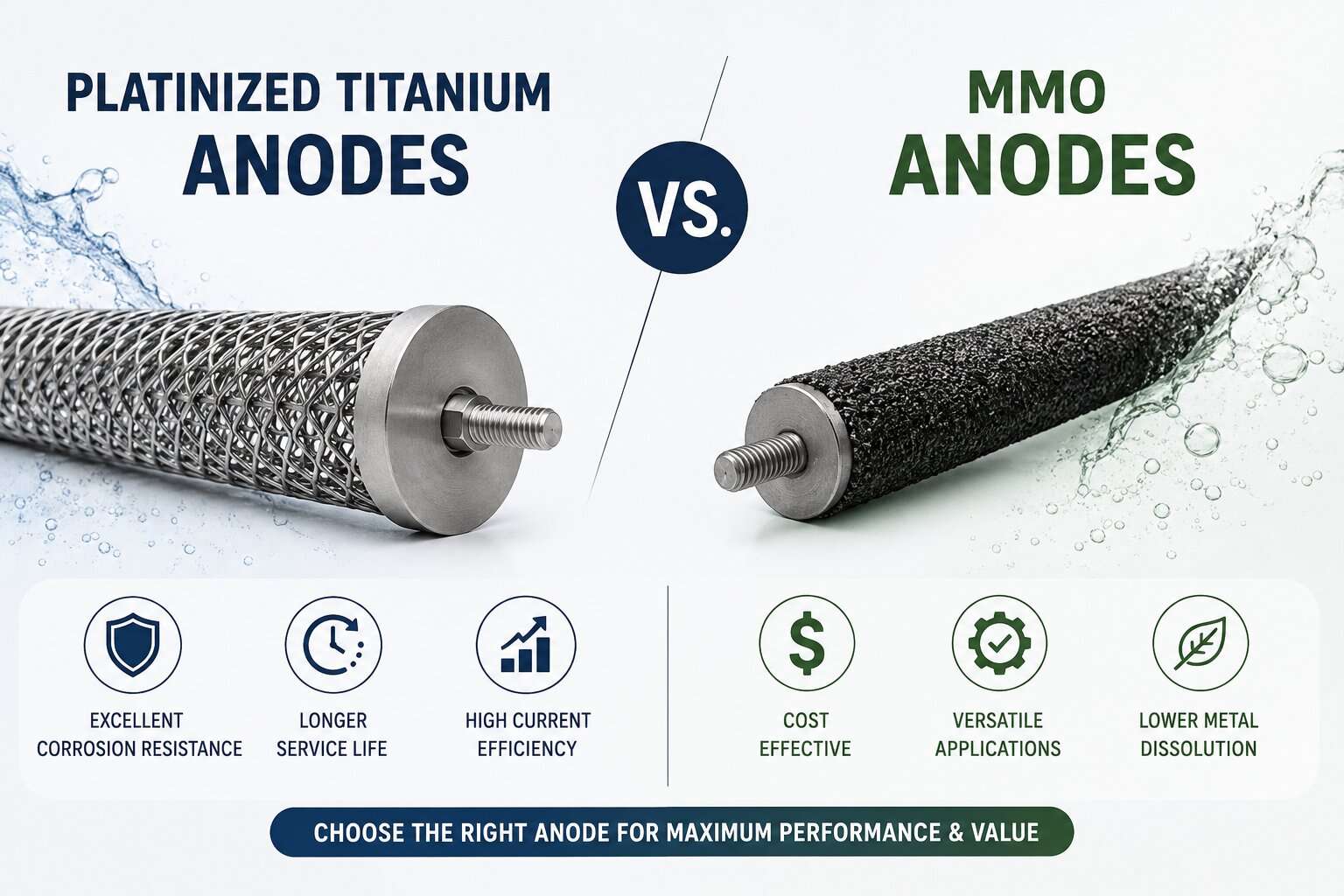
Platinized Titanium Anodes vs. MMO Anodes
Designing an effective Impressed Current Cathodic Protection (ICCP) system requires choosing an anode that balances electrocatalytic efficiency, mechanical durability, and long-term cost. Dimensionally Stable Anodes (DSAs) featuring titanium substrates have largely replaced traditional high-silicon cast iron (HSCI) and graphite anodes because they remain dimensionally stable and offer lower weight and higher current output per unit surface area.
Specifying the optimal electrocatalytic coating—either electrodeposited Pure Platinum or Mixed Metal Oxides (MMO)—requires understanding how each performs under specific operating voltages, current densities, and electrolyte chemistries. Choosing the wrong coating can lead to premature passivation, dielectric breakdown of the titanium oxide film, or accelerated degradation driven by alternating current (AC) ripple.
1. Substrate Metallurgy and Electrocatalytic Coating Chemistry
Both anode types rely on an unalloyed titanium substrate, typically conforming to ASTM B265 Grade 1 or Grade 2. Titanium provides high mechanical strength, light weight, and natural corrosion resistance by forming a self-healing protective titanium dioxide (TiO2) film when polarized anodically in neutral or oxidizing electrolytes.
However, because pure titanium's passive oxide layer is electrically non-conductive, an electrocatalytic surface layer must be applied to pass current into the surrounding electrolyte without causing high overpotential or dielectric failure.
Platinized Titanium Anodes
Platinized titanium anodes are manufactured by electrodepositing a layer of 99.99% pure platinum onto a chemically etched titanium substrate.
Coating Thickness: Typically ranges between 0.5 µm and 5.0 µm (2.5 µm is standard for most industrial ICCP applications).
Bonding Mechanism: Electrodeposition forms a dense, metallic bond directly with the etched substrate. Platinum acts as an inert, noble-metal electrocatalyst that supports high anodic current densities while resisting chemical attack.
Microstructure: Platinized coatings are metallically smooth, but microscopic pinholes or micro-cracks can develop if thick layers (>5.0 µm) are plated without internal stress relief.
Mixed Metal Oxide (MMO) Anodes
MMO anodes are produced by applying a liquid mixture of noble metal salts (such as iridium, ruthenium, or tantalum chlorides) onto a prepared titanium substrate, followed by thermal calcination at temperatures between 450°C and 550°C.
Coating Architecture: The thermal decomposition process builds a crystalline, conductive oxide layer with a porous "mud-crack" structure. This structure maximizes the electrochemically active surface area.
Oxide Formulation:
- Iridium-Tantalum (IrO2 / Ta2O5): Engineered primarily for Oxygen Evolution environments (soil, petroleum coke breeze backfill, fresh water, and concrete). Tantalum oxide acts as a stabilizing matrix that protects the iridium catalyst against acid attack.
- Ruthenium-Titanium (RuO2 / TiO2): Formulated specifically for Chlorine Evolution in high-chloride marine environments and seawater, offering low overpotentials for chlorine gas generation.
2. Electrochemical Performance, Reaction Kinetics, and Consumption Rates
Anode longevity depends on the electrochemical reactions occurring at the anode-electrolyte interface. The dominant oxidation reaction dictates the operational wear rate of the electrocatalytic layer.
- Fresh Water / Soil / Concrete: Dominant Reaction = Oxygen Evolution (2H2O → O2 + 4H+ + 4e-)
- Seawater / Brine / Chlorides: Dominant Reaction = Chlorine Evolution (2Cl- → Cl2 + 2e-)
Oxygen Evolution vs. Chlorine Evolution Kinetics
In freshwater, soil, or concrete, the primary anodic reaction is the oxidation of water to produce oxygen gas (O2) and hydrogen ions (H+). This lowers the local pH, creating a localized acidic micro-environment at the anode surface:
2H2O → O2 + 4H+ + 4e-
Platinum electrocatalysts undergo slow oxidative dissolution under strong oxygen evolution conditions, which increases their consumption rate. Conversely, IrO2 / Ta2O5 MMO coatings resist acidic degradation under oxygen evolution, maintaining catalytic activity without rapid dissolution.
In seawater and saline electrolytes, chlorine evolution dominates:
2Cl- → Cl2 + 2e-
Both platinum and RuO2-based MMO coatings exhibit low chlorine overpotentials in seawater, resulting in exceptionally low consumption rates and long service lives.
Consumption Rate Comparison
| Anode Type | Operating Environment | Typical Consumption Rate | Degradation Mechanism |
|---|---|---|---|
| Platinized Titanium | Seawater / Marine | 0.005 – 0.010 g/A·yr | Electrochemical dissolution & oxidation |
| Platinized Titanium | Fresh Water / Soil | 0.100 – 0.300 g/A·yr | Rapid dissolution under oxygen evolution |
| MMO (IrO2 / Ta2O5) | Fresh Water / Soil / Coke | 0.5 – 2.0 mg/A·yr | Slow oxide depletion & micro-spalling |
| MMO (RuO2 / TiO2) | Seawater / Salt Water | 0.1 – 0.5 mg/A·yr | Catalytic depletion |
Note: MMO consumption is measured in milligrams per ampere-year (mg/A·yr), whereas platinum dissolution is measured in grams per ampere-year (g/A·yr). MMO oxide layers wear down 50 to 100 times slower by weight than electrodeposited platinum under equivalent current discharge.
3. Passivation Limits, Breakdown Voltage, and AC Ripple Sensitivity
Understanding electrical operating thresholds prevents catastrophic ICCP system failure.
Titanium Substrate Breakdown Voltage
When the electrocatalytic coating (platinum or MMO) is depleted or physically damaged, the exposed underlying titanium polarizes anodically. If the impressed DC output voltage exceeds the substrate's dielectric breakdown voltage, the passive TiO2 layer undergoes pitting breakdown, leading to rapid localized substrate loss.
In Chloride Environments (Seawater/Brine): Titanium breakdown occurs at approximately 12V.
In Low-Chloride Fresh Water / Soil: Breakdown typically occurs between 50V and 60V.
Engineering Rule: In high-resistivity soils or deep groundbeds requiring an operating terminal voltage higher than 12V in the presence of chlorides, Platinized Titanium is at risk if depleted. For these higher-voltage applications, specify Platinized Niobium (Pt/Nb) or Platinized Tantalum (Pt/Ta) substrates, which possess dielectric breakdown thresholds exceeding 100V.
- Titanium Substrate in Chlorides (Seawater): Breakdown occurs above 12V DC
- Titanium Substrate in Low-Chloride Fresh Water: Breakdown occurs between 50V and 60V DC
- Niobium Substrate (Pt/Nb) in Chlorides: Breakdown occurs above 100V DC
Rectifier AC Ripple Current
Unfiltered transformer-rectifiers generate alternating current (AC) ripple superimposed on the direct current (DC) output.
Impact on Platinum Coatings: AC ripple exceeding 5% RMS causes alternating oxidation and reduction cycles on the platinum surface, causing rapid platinum dissolution and premature failure.
Impact on MMO Coatings: Crystalline MMO oxide structures tolerate AC ripple better than electrodeposited metals. However, high AC density (>20 A/m²) can still cause micro-cracking and loss of coating adhesion.
Design Requirement: Always specify cathodic protection rectifiers equipped with DC smoothing chokes that maintain output AC ripple below 5% RMS when using platinized anodes.
4. Engineering Design Life Calculation Formula
CP engineers calculate the required active coating mass based on target operating current and design life requirements (aligned with AMPP/NACE SP0169 guidelines).
Mathematical Formula for Anode Service Life
To determine the design life of an anode system, use the following equation:
L = (M × U) / (I × K)
Where:
- L = Design service life in years (yr)
- M = Total mass of active electrocatalytic coating installed (g for Pt; mg for MMO)
- U = Anode utilization factor (typically 0.80, representing an 80% maximum consumption allowance prior to decommissioning)
- I = Total continuous DC output current (A)
- K = Verified consumption rate of the catalytic coating in the specific electrolyte (g/A·yr for Pt; mg/A·yr for MMO)
Practical Calculation Example
Scenario: A deep well groundbed discharging 30 A continuous DC in soil/coke breeze backfill with a target life of 20 years.
Option A (Platinized Titanium)
Assuming K = 0.15 g/A·yr and U = 0.80:
M = (L × I × K) / U
M = (20 × 30 × 0.15) / 0.80 = 112.5 grams of pure Platinum
At current PGM market rates, applying 112.5 g of pure electrodeposited platinum per groundbed significantly increases initial capital costs.
Option B (IrO2 / Ta2O5 MMO Tubular)
Assuming K = 1.0 mg/A·yr (0.001 g/A·yr) and U = 0.80:
M = (20 × 30 × 0.001) / 0.80 = 0.75 grams of active Oxide loading
The lower material mass requirement explains why MMO anodes are generally more cost-effective for long-life soil groundbeds.
5. Environment-Specific Selection Matrix & Form Factors
Selecting the ideal anode involves matching the electrolyte resistivity, operating current density, and mechanical requirements with the appropriate form factor.
Primary Recommendation: MMO Tubular or Canister Anodes (IrO2 / Ta2O5).
Operating Current Density Limit: 50 – 100 A/m² (based on coke breeze contact area to prevent gas blockage).
Engineering Rationale: MMO tubular strings provide low connection resistance, simple assembly in deep wells, and high resistance to acidic gases (CO2, Cl2) trapped in deep backfills.
Marine, Seawater & Offshore Structures
Primary Recommendation: MMO Wire/Ribbon or Platinized Titanium Rod/Wire Anodes.
Operating Current Density Limit: Up to 600 A/m² for MMO (RuO2 based); up to 1,000 A/m² for Platinized Titanium.
Engineering Rationale: High salinity reduces circuit resistance, allowing high current discharge. For compact marine installations (like condenser water boxes or internal vessel cathodic protection), platinized wire or rod stock operates effectively under high fluid flow velocity without physical coating damage.
Aboveground Storage Tank (AST) Bottoms
Primary Recommendation: MMO Continuous Ribbon Anodes installed in grid patterns beneath new tank sand cushions.
Operating Current Density Limit: 10 – 40 mA/m of ribbon length.
Engineering Rationale: Flexible titanium ribbon (6.35 mm width) coated with IrO2 / Ta2O5 delivers uniform current distribution across tank floor plates, eliminating shielded areas common with distant groundbeds.
Reinforced Concrete Structures (Bridges, Port Structures)
Primary Recommendation: MMO Expanded Titanium Mesh or Strip Anodes embedded in mortar overlays.
Operating Current Density Limit: 10 – 20 mA/m² of concrete surface area (AMPP SP0290 compliance).
Engineering Rationale: Low current output per unit area prevents acid buildup at the concrete interface, preserving structural bond strength while arresting rebar corrosion.
6. Technical & Specification Summary
| Feature / Metric | Platinized Titanium Anodes | MMO Titanium Anodes (Ir-Ta / Ru-Ti) |
|---|---|---|
| Base Material Standard | ASTM B265 Grade 1 or Grade 2 Titanium | ASTM B265 Grade 1 or Grade 2 Titanium |
| Electrocatalyst Layer | 99.99% Pure Electrodeposited Platinum | Calcinated Mixed Metal Oxides (IrO2, Ta2O5, RuO2) |
| Standard Coating Mass/Thickness | 1.5 µm, 2.5 µm, or 5.0 µm | 6 – 12 g/m² catalytic oxide loading |
| Primary Reactions Supported | Chlorine & Oxygen Evolution | Specially tuned for Oxygen OR Chlorine |
| Seawater Current Density Limit | 1,000 – 3,000 A/m² | 600 – 1,200 A/m² |
| Soil/Coke Current Density Limit | 50 – 100 A/m² | 50 – 100 A/m² |
| Consumption Rate (Fresh Water/Soil) | High (0.10 – 0.30 g/A·yr) | Exceptionally Low (0.5 – 2.0 mg/A·yr) |
| Consumption Rate (Seawater) | Low (0.005 – 0.010 g/A·yr) | Exceptionally Low (0.1 – 0.5 mg/A·yr) |
| Dielectric Breakdown Voltage | 12V DC (Seawater) / 50V (Fresh Water) | 12V DC (Seawater) / 50V (Fresh Water) |
| AC Ripple Sensitivity | High (Requires <5% RMS Ripple) | Moderate (Tolerates minor ripple better) |
| Common Physical Geometries | Wire, Rod, Mesh, Sheet | Tubular, Ribbon, Wire, Mesh, Disc |
| Relative Capital Cost (CAPEX) | High (Tied to precious metal market prices) | Moderate to Low |
7. Lifecycle Cost Analysis and Procurement Quality Control
Evaluating overall economics requires balancing upfront material costs (CAPEX) with operating and maintenance expenditures (OPEX) over the full target service life of the asset.
Total Lifecycle Cost = Initial Anode CAPEX + Cable/Groundbed Installation + System Monitoring OPEX + Failure Replacement Cost
CAPEX vs. OPEX Considerations
Initial Cost (CAPEX): MMO anodes generally deliver lower upfront material costs per output ampere because oxide loading requires much smaller quantities of precious metals than electrodeposited platinum.
Replacement Risk (OPEX): In high-voltage groundbeds or deep wells, replacing a failed anode string can cost significantly more than the original equipment. MMO’s resistance to oxygen evolution in soil and water reduces the risk of premature failure.
Quality Control Checklist for Procurement Engineers
When specifying and procuring DSAs, require vendor documentation confirming compliance with industry standards:
- Substrate Verification: Require material test reports (MTRs) confirming ASTM B265 Grade 1 or 2 Titanium to ensure ductility and chemical resistance.
- Coating Adhesion & Thickness Testing:
Platinized Anodes: Verify electrodeposited layer thickness via cross-sectional micro-examination (ASTM B487) or X-ray Fluorescence (XRF) analysis per ASTM B568.
MMO Anodes: Confirm oxide loading (g/m²) using XRF testing and verify coating adhesion via thermal stress testing.
- Accelerated Life Testing: Request third-party test reports confirming compliance with NACE TM0108 (Testing of Catalytic Coatings and Anodes for Use in Cathodic Protection).
- Cable Connection Integrity: Ensure factory-assembled lead wire connections (e.g., dual-layer HALAR/HMWPE cables) are hermetically sealed using resin-encapsulated compression sleeves to prevent water ingress and cable-to-anode connection failure.
Leave Your Comments
Recent Post