


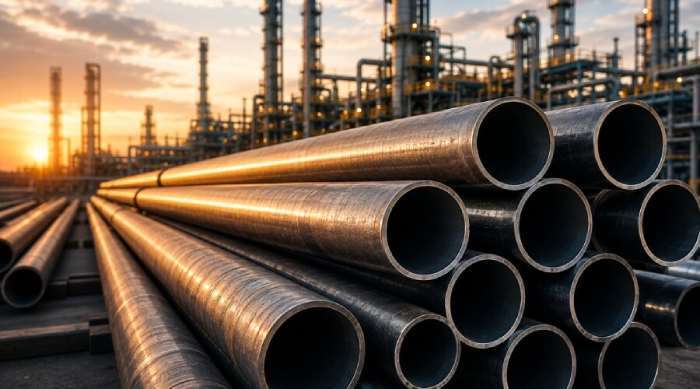
Steel Pipes Guide: Types, Grades & Buyer's Checklist | Platinum
Every piping system starts with one decision that shapes everything downstream: which steel pipe is right for the job. Choose wrong, and you're looking at premature corrosion, pressure failures, or a project stalled while replacement stock ships in. Choose right, and the pipe practically disappears into the background doing its job for decades without a second thought.
At Platinummet, we supply steel pipes to processing plants, EPC contractors, and OEM fabricators who don't have room for that kind of risk. If you've read our guides on stainless steel flanges or nickel alloys, you'll know piping components are only as reliable as the weakest part of the system and the pipe itself is where that reliability starts. Here's what actually matters when you're specifying or sourcing steel pipe.
Seamless vs. Welded: The First Fork in the Road
Every steel pipe starts as one of two things.
Seamless pipes are pierced and drawn from a solid billet, with no weld seam anywhere along their length. That uniformity gives them higher pressure ratings and better performance in high-stress, high-temperature service think refinery lines, boiler feed systems, and offshore applications where a weld seam is one more place for something to go wrong.
Welded pipes (ERW, SAW, or EFW, depending on the process) are formed from rolled steel plate or coil, with the seam fused shut. Modern welding and inspection have closed much of the performance gap with seamless pipe, and welded pipe typically costs less and is available in larger diameters more easily. For water lines, structural applications, and moderate-pressure service, welded pipe is often the smarter economic choice.
Neither is universally "better" it's a question of matching the manufacturing method to the pressure, temperature, and criticality of the application.
| Pressure rating | Higher, more consistent | Good, slightly lower ceiling |
| Cost | Higher | More economical |
| Large diameters | Harder to source | Widely available |
| Best for | High-pressure, high-temp, critical service | Water lines, structural, moderate pressure |
| Typical standards | ASTM A106, API 5L (seamless) | ASTM A53, API 5L (welded), ASTM A252 |
A quick way to think about it: if a failure would shut down the plant or endanger people, lean seamless. If the line is carrying water, air, or low-hazard fluid at moderate pressure, welded pipe does the job at a better price point.
Choosing the Right Material Grade
Steel pipe isn't one material it's a family, and the grade determines what environment it can survive in.
- Carbon steel pipes (ASTM A106, A53) are the workhorses of general piping cost-effective, strong, and suitable for moderate temperatures and non-corrosive or mildly corrosive media.
- Stainless steel pipes (ASTM A312, grades 304/304L, 316/316L) resist corrosion from chlorides, acids, and moisture, making them the default for chemical processing, pharmaceuticals, food-grade lines, and marine environments.
- Alloy steel pipes (ASTM A335, P11, P22, P91) are built for high-temperature, high-pressure service power generation, petrochemical units, and anywhere thermal creep resistance matters.
- Duplex and super duplex grades combine high strength with excellent corrosion resistance, earning their premium price tag in offshore and high-chloride service where failure isn't an option.
The right grade balances three things: what's flowing through the pipe, what pressure and temperature it will see, and how long the installation needs to last without intervention.
If your project also involves connecting components flanges, valves, or fittings the grade of pipe should match the grade of those parts. Mixing a 316 stainless pipe with a lower-grade fitting is a common (and avoidable) source of galvanic corrosion at the joint. See our guide on stainless steel flanges for how we approach grade-matching across a full piping assembly.
A Note on Wall Thickness and Schedule
Grade determines what the pipe resists; schedule determines how much pressure it can take before it does. Pipe schedule (Sch 10, 40, 80, 160, and beyond) refers to the wall thickness relative to the pipe's outer diameter a higher schedule number means a thicker wall and a higher pressure rating, but also more weight and material cost. Under-speccing schedule to save on material is one of the most common (and most expensive) mistakes we see on new projects, because retrofitting a pressure-rated system after installation is far costlier than ordering the right schedule up front.
What Steel Pipes Are Used For
- Oil & Gas: Gathering lines, refinery process piping, and transmission pipelines that operate under sustained pressure and demanding fluid conditions.
- Power Generation: Boiler tubing and steam lines where alloy steel handles extreme heat without losing structural integrity.
- Water & Wastewater: Municipal supply and treatment infrastructure, where welded carbon or stainless steel pipe balances cost with long service life.
- Construction & Structural: Load-bearing steel pipe used in scaffolding, foundations, and structural framing.
- Chemical & Pharmaceutical Processing: Stainless steel pipe that won't react with or contaminate the media it carries.
Many of these systems also rely on rotors and valves to control flow at key points along the pipe run worth reviewing if you're specifying a full system rather than pipe alone.
A Practical Buyer's Checklist
Before you place an order, run through these:
- Nominal Pipe Size (NPS) and Schedule — confirm the outer diameter and wall thickness match your system design and pressure rating.
- Standard and Grade — specify the exact ASTM/ASME/API standard (A106, A312, A335, API 5L) so there's no ambiguity in mill certification.
- Manufacturing Process — seamless or welded, based on your pressure and budget requirements.
- End Finish — plain end, beveled for welding, or threaded, depending on how the pipe will be joined downstream.
- Testing and Certification — hydrostatic testing, NDT, and mill test certificates (MTC) confirming compliance, especially for pressure-critical or export projects.
- Coating and Corrosion Protection — galvanized, epoxy-coated, or bare, depending on the operating environment.
- Lead Time and Volume — for large projects, confirm the supplier can deliver consistent mill quality across the full order, not just the sample.
Skipping any one of these is how a piping system ends up over-spec'd and overpriced, or under-spec'd and unreliable.
Why It's Worth Getting This Right
Steel pipe is a small line item on a project budget compared to the systems it feeds into but it sits underneath all of them. A pipe that's under-rated for its service conditions doesn't just risk a leak; it risks unplanned downtime, safety incidents, and the cost of tearing out and re-running a line that should have lasted the life of the plant.
That's the standard we hold our own supply to. As a global steel pipe supplier, Platinummet works with processing plants, contractors, and OEMs who need mill-certified pipe, consistent quality across bulk orders, and delivery timelines that don't put their project schedule at risk.
Need help specifying the right steel pipe for your project? Contact Platinummet for grade selection, technical documentation, or a bulk quote.
Leave Your Comments
Recent Post
Platinum Cladding vs. Electroplating
07-Oct-2026
Platinized Titanium Anodes vs. MMO Anodes
02-Oct-2026
What Is a Flange Butterfly Valve
15-Sep-2026