

Industrial Rotors Guide: Types & Applications | PMI
Rotors don't get much attention outside the industries that depend on them, but inside a shredding, recycling, or processing system, they're doing most of the actual work. A rotor is the rotating component that drives cutting, shredding, or mixing action, and the design choices behind it directly affect throughput, material quality, and how often a system needs maintenance.
At Platinum Metals Industries LLC (PMI), rotors are one of our core product categories, supplied to recycling, manufacturing, and metal processing operations. Here's a look at what industrial rotors do, the most common types, and what matters when choosing one for a given application.
What Is an Industrial Rotor?
In the simplest terms, a rotor is a rotating shaft fitted with blades, hammers, or cutting elements, driven by a motor to perform mechanical work on a material. In shredding and recycling equipment specifically, rotors are responsible for breaking down scrap metal, plastic, wood, or other bulk material into smaller, more manageable pieces.
The rotor's design, speed, and configuration determine how effectively a machine processes material. A rotor built for shredding lightweight plastic won't perform the same way on dense metal scrap, which is why rotor selection is closely tied to the specific material a system is meant to handle.
Common Types of Industrial Rotors
Single shaft rotors use one rotating shaft fitted with cutting blades or hooks, typically paired with a stationary counter-blade to shear material as it passes through. These are common in applications where uniform particle size matters, such as plastic or wood shredding.
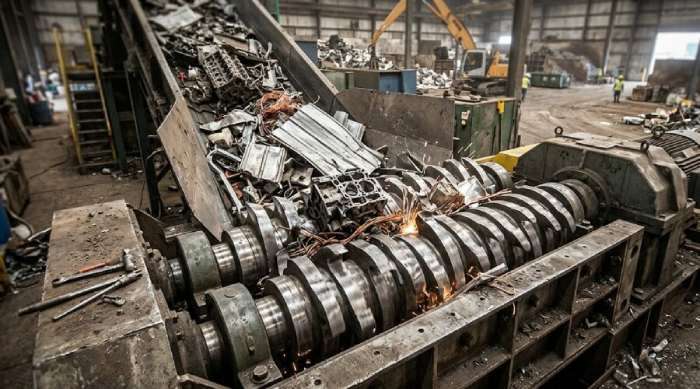
Twin shaft rotors use two parallel rotating shafts that work together, often at different speeds, to pull material through and tear it apart between the two sets of blades. This design handles a wider range of material types and is particularly effective on bulky, mixed, or tougher scrap that a single shaft system might struggle with. Twin shaft rotors are widely used in metal recycling and heavy-duty shredding applications where material consistency varies from batch to batch.
Hammer mill rotors use swinging or fixed hammers attached to a rotating shaft to break material apart through repeated impact rather than shearing. These are often used for friable materials that break apart more easily under impact than under a cutting action.
Granulator rotors are designed for finer size reduction, typically used in a secondary processing stage after initial shredding, where the goal is to bring material down to a smaller, more uniform particle size for further processing or resale.
Why Twin Shaft Rotors Are Common in Metal Recycling
Metal scrap is rarely uniform. A single load might contain everything from thin sheet metal to thick structural sections, and a rotor system needs to handle that inconsistency without constant jamming or excessive wear.
Twin shaft rotors are built for exactly this kind of variability. Because two shafts work together, often rotating at different speeds, the system can pull in irregular or bulky material and tear it apart more effectively than a single shaft design. This makes twin shaft rotors a common choice in metal recycling facilities, where feedstock consistency can't be guaranteed and the equipment needs to keep running through a wide range of material types and sizes.
The trade-off is complexity. Twin shaft systems have more moving parts and require more careful maintenance than simpler single shaft designs, but for operations processing mixed or heavy scrap at volume, that trade-off is usually worth it.
What to Consider When Sourcing a Rotor
Choosing the right rotor isn't just about picking a type. A few practical factors tend to matter most in the decision.
Material type and consistency play the biggest role. A rotor built for clean, uniform plastic won't necessarily hold up well on mixed metal scrap, and the reverse is also true. Matching the rotor's design to your actual feedstock is the starting point for any sourcing decision.
Wear resistance matters just as much as initial cutting performance. Rotors that process metal or other abrasive material need blades and components built from alloys that can withstand repeated impact and friction without degrading quickly. A rotor that performs well initially but wears out within months ends up costing more in replacement parts and downtime than a properly specified one would have upfront.
Maintenance and replaceable parts availability is another factor worth checking before committing to a supplier. Rotors are wear components by nature, and having reliable access to replacement blades, bearings, or shaft components keeps a system running without long downtime waiting on parts.
Why Material Quality in Rotor Components Matters
A rotor's frame might hold up fine, but if the cutting blades or wear components are made from a lower-grade alloy than what the application demands, performance drops off fast. This is especially true in metal recycling, where the rotor itself is constantly being worn down by the material it's processing.
Sourcing rotor components from a supplier who can verify material composition and grade, rather than relying on a general description, helps ensure the parts going into a system will actually perform and last as expected.
Final Thoughts
Rotors are the part of a shredding or recycling system doing the heaviest mechanical work, and the right configuration, whether single shaft, twin shaft, or another design, depends entirely on the material being processed and how consistently that material shows up. Getting this choice right has a direct impact on throughput, downtime, and long-term operating costs.
Platinum Metals Industries LLC supplies industrial rotors alongside a broader range of metal products, backed by ISO certification, XRF testing, and more than 15 years supplying industries across 30+ countries. If you're sourcing rotors for an upcoming project, get in touch with our team to talk specs and request a quote.