

Platinum-Rhodium vs Base Metal Thermocouples
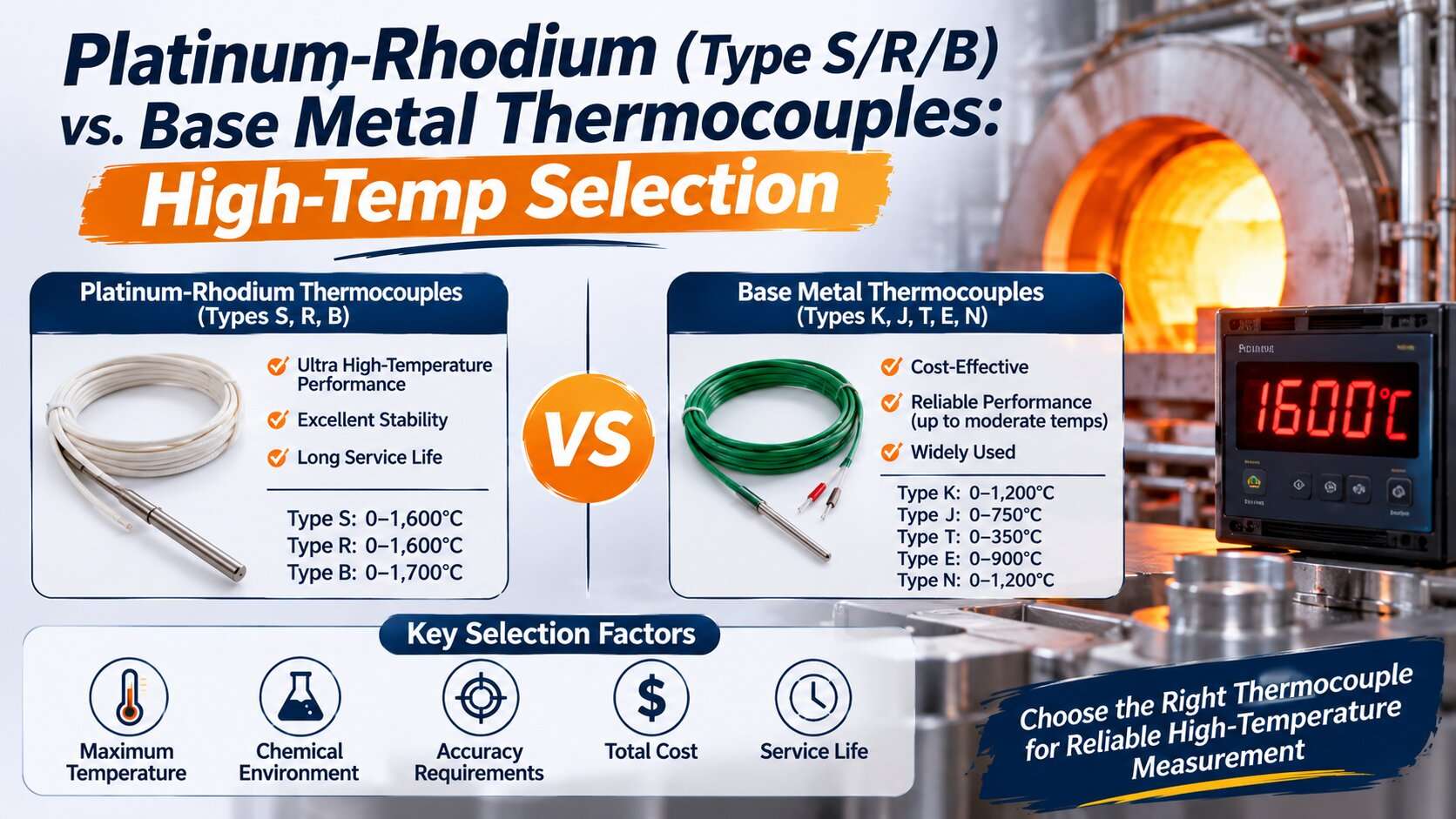
Below about 1,000 °C, a base-metal thermocouple (Type K or N) is the default choice. Above roughly 1,450 °C in air, Type B is the standard choice. The hard decision sits between 1,100 and 1,450 °C, where Type N, Type R and Type S can all work. The right pick depends on atmosphere, accuracy target, wire diameter and how often you can afford to replace the sensor.
This guide covers that decision. It compares platinum-rhodium (Pt-Rh) Types S, R and B with base-metal types on ranges, as-delivered tolerance, drift, contamination, protection hardware and cost of ownership.
Quick Selection: Temperature, Atmosphere and Accuracy
| Service condition | Start with | Why | Watch for |
|---|---|---|---|
| Continuous use up to about 1,000 °C, oxidizing or inert | Type K, or N where stability matters | High output, lowest cost, Class 1 tolerance available to 1,000 °C | Hysteresis drift at 200–600 °C; green rot in sulfurous or marginally oxidizing gas |
| 1,000–1,200 °C, clean air, long runs | Type N in a compatible sheath | Reported reliable for extended periods to at least 1,200 °C | Class 2 tolerance only; not every N formulation beats K |
| 1,200–1,450 °C, oxidizing, tighter accuracy needed | Type R or S in high-purity alumina | Class 1 tolerance available | Contamination, grain growth in the pure platinum leg |
| Above about 1,450 °C, or long service near the Pt-Rh ceiling | Type B | Best long-term mechanical strength above 1,100 °C | Useful only above about 600 °C; less repeatable than R/S |
| Reducing gas, hydrogen, vacuum, high carbon | Neither family is easy | Pt-Rh needs a sealed ceramic; K suffers green rot | Above about 1,750 °C, tungsten-rhenium types take over |
| Silicon, metal vapour or refractory contact | Sheathed base metal, unless Pt-Rh is fully isolated | Base metals are generally less sensitive to contamination | One breached tube ruins a platinum element |
| Calibration or reference duty | Type S (or R) | Lowest uncertainty of the standard types | Needs annealing and clean handling |
Every Pt-Rh row assumes high-purity ceramic insulation and a gas-tight tube. Without those, the ranges below do not apply.
What the Standards Guarantee
IEC 60584-1:2013 and ASTM E230 define the letter types. Both define reference functions, and both set tolerances for wire as delivered.
| Type K | Type N | Type S | Type R | Type B | |
|---|---|---|---|---|---|
| Alloy | NiCr / NiAl | NiCrSi / NiSi | Pt-10%Rh / Pt | Pt-13%Rh / Pt | Pt-30%Rh / Pt-6%Rh |
| Defined range | −270 to 1,300 °C | −270 to 1,300 °C | −50 to 1,768 °C | −50 to 1,768 °C | 0 to 1,820 °C |
| IEC Class 1 range | −40 to 1,000 °C | −40 to 1,000 °C | 0 to 1,600 °C | 0 to 1,600 °C | Not defined |
| IEC Class 2 range | −40 to 1,200 °C | −40 to 1,200 °C | 0 to 1,600 °C | 0 to 1,600 °C | 600 to 1,700 °C |
| Sensitivity | about 41 µV/°C | about 39 µV/°C | about 10 µV/°C | about 10–12 µV/°C | about 9 µV/°C at working heat, near zero below 50 °C |
Pt-Rh types give roughly a quarter of the signal of Types K and N. That has instrument consequences, covered below.
Three different “maximum temperatures”
Published limits run from 1,300 °C to 1,820 °C because sources quote different things.
- Defined range: where the reference function exists. This is a calibration boundary, not a service rating.
- Tolerance range: where the standard’s classes apply. R/S go to 1,600 °C and B to 1,700 °C.
- Continuous service: the BIPM secondary-thermometry guide puts this typically about 200 °C below the upper limit. It gives roughly 1,300 °C continuous for R/S in oxidizing atmospheres, and roughly 1,500 °C for B. Catalogues are more generous. Omega rates R/S at 1,398 °C continuous. Peak Sensors lists R and S at 1,400 °C, B at 1,500 °C, K at 1,100 °C and N at 1,200 °C.
All of these depend on wire diameter. Thicker wire survives hotter service, and BIPM’s R/S figures assume 0.5 mm wire. Compare any two datasheets at the same diameter.
Tolerance at 1,200 °C
The standards publish formulas. Applied at 1,200 °C, the larger of the fixed and percentage terms governs:
| Grade | Tolerance at 1,200 °C |
|---|---|
| Type K or N, IEC Class 2 | ±9.0 °C |
| Type K, ASTM special limits | ±4.8 °C |
| Type R or S, IEC Class 1 | ±1.3 °C |
| Type R or S, IEC Class 2 (or ASTM standard) | ±3.0 °C |
| Type R or S, ASTM special limits | ±1.2 °C |
Under IEC, K and N have no Class 1 above 1,000 °C. At 1,200 °C the best available base-metal grade is about seven times looser than a Class 1 platinum couple.
Type B has no Class 1. At 1,500 °C, Class 2 gives ±3.75 °C and Class 3 gives ±7.5 °C.
These figures apply to new wire. The IEC corrigendum states that tolerances do not allow for calibration drift in use. Tolerance class does not predict how a sensor reads after six months in the furnace.
How Each Family Fails Above 1,000 °C
Base metals
Oxidation and composition change. BIPM reports that bare Type K wire in air above about 600 °C shows a slow, irreversible rise in Seebeck coefficient of about 1% per 1,000 hours at 1,000 °C. A steel-sheathed K probe moves the other way: about −10 °C in 1,000 hours at 1,100 °C, from manganese migrating out of the sheath. Sheaths matched to the wire’s composition, sold as integrally designed MIMS (ID-MIMS) under names like Nicrobell and Pyrosil, hold up better at high temperature.
Hysteresis. Type K drifts in the 200–600 °C band from short-range ordering, with typical effects of 1–4 °C and reports up to 8 °C. Type N shows two to four times less, shifted to 500–1,000 °C and peaking near 700 °C. This matters even in a 1,200 °C process, because part of the wire always sits in the cooler band of the furnace wall gradient. BIPM adds that Type K calibrations are ineffective unless done in situ, because hysteresis changes the curve.
Atmosphere. K and N suit oxidizing and inert atmospheres. In low-oxygen or sulfurous gas, Type K’s chromium-bearing leg suffers green rot, with Seebeck losses in the tens of percent in extreme cases.
Type N is not automatically better. Because the standard defines the thermocouple by reference function, not composition, BIPM notes that some commercial Type N formulations perform worse than typical K. Ask for a formulation and sheath, not just a letter.
Platinum-rhodium
Pt-Rh wire is chemically noble but physically fragile and easily poisoned.
Contamination is the main cause of drift. BIPM names iron from insulation as the largest effect. Adding 0.1 wt% iron to pure platinum changes its average Seebeck coefficient over 400–1,100 °C by 1.7 µV/K, against 0.75 for chromium, 0.64 for silicon, 0.33 for nickel, 0.21 for rhodium and 0.15 for copper. On a couple that yields about 10 µV/°C in total, that is a large share of the signal.
A study summarised in a NASA technical report held Pt13Rh/Pt pairs in argon at 1,650 K (about 1,377 °C) for 120 hours. Low-purity alumina insulators shifted the output by the equivalent of 96 K. High-purity alumina shifted it by about 2 K.
Silicon is the failure mode that ends sensors. In reducing conditions or vacuum, siliceous refractories release silicon. BIPM notes that it embrittles platinum, and a platinum-silicon eutectic forms that melts at 816 °C.
Rhodium moves. Above 600 °C rhodium oxide can diffuse between legs, and above 1,100 °C rhodium also migrates as a metallic vapour. The net effect is a slow drift. Johnson Matthey’s metallurgy literature describes rhodium moving from the positive to the negative leg. Using one twin-bore insulator, not segmented sections, limits it.
Grain growth breaks the pure platinum leg. Above about 1,100 °C, the pure platinum leg of Types R and S grows large grains and becomes fragile. A wire supplier describes the end state as a “bamboo” chain of grains, with failure at the transverse boundaries. ISA notes that long high-temperature exposure of R and S leads to mechanical failure and negative drift. Type B has no pure-platinum leg, which is why it holds up better in long service above 1,100 °C.
Below 1,100 °C the drift is smaller but real. BIPM cites about +0.5 °C after 24 hours at 500 °C from ordering, and about −0.25 °C after 24 hours at 900 °C from oxidation. Both are reversible by annealing. Contamination is not.
Drift is generated where the gradient is
BIPM’s key point is that thermocouple voltage arises along the wire wherever there is a temperature gradient, not at the junction. Whatever degrades the wire in the gradient zone, whether ordering, oxidation, cold work or contamination, produces the error. For both families, that zone is at the furnace wall and refractory, not at the tip. Insertion depth and where the wire bends are therefore calibration decisions. Keep the junction and any bends in an isothermal zone, and run the hot section deep enough that the gradient falls on undamaged, supported wire.
Choosing Within Pt-Rh: S, R or B
R vs. S. The two differ by 3% rhodium in the positive leg. R produces roughly 12% more output than S, and BIPM calls R very slightly more stable. Their performance and application ranges are otherwise very close, but the curves differ, so they are not interchangeable. An instrument set to S will misread an R couple by a wide margin at high temperature. S is the long-established reference type and the usual choice where traceability and lab practice matter. R is the common industrial pick.
Type B. B pairs Pt-30%Rh with Pt-6%Rh, so neither leg is pure platinum. That gives better mechanical life above 1,100 °C and less sensitivity to rhodium transfer and metal contamination.
It costs repeatability. BIPM explains that ordering and oxidation effects in the two alloy legs have opposite signs, so the combined effect is larger and less repeatable than in R and S. That reconciles the conflicting advice you will find, where one source calls B more drift-prone and another calls it more stable. B resists breakage and contamination better, but it is less repeatable in the reference sense.
B has three practical quirks:
- Low-temperature output: the output is the same at 0 °C and about 42 °C, with a minimum near 21 °C. Avoid readings below about 50 °C, and expect to use B only above about 600 °C, where IEC Class 2 begins.
- Reference junction: near-zero output makes the loop insensitive to reference-junction temperature, and BIPM says compensation is unnecessary in some applications. Both thermoelements must still be at the same temperature there.
- Cable: extension wire for B is copper against copper (or copper-manganese), good to about 100 °C. One supplier notes it can introduce a deviation of up to −3.7 °C when the thermocouple is above 1,000 °C.
R and S need standard cold-junction compensation and compensating cable made from copper alloys, per IEC 60584-3. Both cable types are used between 0 and 100 °C.
Protection and Installation That Decide Service Life
For Pt-Rh, protection hardware is half the specification.
- Tube material: use high-purity alumina (99.7% Al₂O₃). Tempco recommends alumina tubes and insulators above about 1,093 °C because silica is a prime platinum contaminant. JMS advises alumina over mullite except in oxidizing atmospheres, because silicon in mullite can contaminate Pt-Rh. Mullite tubes are rated to about 1,700 °C against about 1,870 °C for alumina, and both are sensitive to thermal shock.
- Insulator: one twin-bore insulator, with segmented insulator sections discouraged above 500 °C because they promote rhodium transfer. BIPM recommends baking insulators at about 1,200 °C before assembly.
- Metal contact: keep Pt-Rh away from base-metal sheaths and thermowells at temperature, since iron and nickel migrate into platinum. Exceptions exist, such as Pt-Rh alloy MIMS sheaths with balanced rhodium. For ordinary assemblies, use a ceramic inner tube inside any metal outer tube.
- Heat-up: preheat ceramic tubes before installing them in a hot process. JMS suggests about 480 °C.
- Cable and head: keep the head and extension leads below about 50 °C, and use a head transmitter. ISA notes that raw millivolt signals pick up noise.
- Instrument resolution: BIPM recommends a voltmeter resolution of 1 µV or better for noble-metal couples, about 0.1 °C. A 10 µV resolution is about 0.3 °C and often acceptable for base metal. A 1 µV error is about 0.1 °C on R/S but only about 0.025 °C on Type K.
Base-metal assemblies need less ceremony. Choose a sheath for the atmosphere and the temperature, and treat survival limits as ceilings, not recommended working temperatures.
Cost of Ownership: Noble vs. Base Metal
Do not compare sensor prices. Compare cost per year of reliable measurement.
For one measuring point:
Annual cost = (assembly price + installation labour + downtime cost per change) ÷ service life in years + recalibration cost + cost of measurement error
A noble-metal assembly pays off when its cost multiple over the base-metal probe is smaller than its life multiple. If it costs 15 times as much, it must outlast 15 base-metal probes, or save an equivalent amount through avoided drift and downtime.
Platinum pricing is driven by wire diameter and precious-metal markets. Omega UK list prices retrieved for this article show a 12-inch Type S assembly with alumina tube and head at £629 in 30 AWG (0.25 mm), £1,812 in 24 AWG (0.5 mm) and £3,973 in 20 AWG (0.8 mm). Type B was £732, £1,980 and £4,738 for the same gauges. Omega states its prices move with precious-metal markets. Ask for a current quote.
No source gives a lifespan figure for Pt-Rh or base-metal probes that holds across applications. Life depends on temperature, wire diameter, atmosphere, thermal cycling and tube quality. Ask suppliers for field data from similar service, and track your own replacement intervals.
Typical Applications
| Application | Temperature | Commonly specified |
|---|---|---|
| Heat treating, annealing | up to about 1,100 °C | K or N probes |
| Glass forehearth, reformer thermowells | 1,100–1,500 °C | R or S in ceramic protection |
| Ceramic kilns, sintering | 1,100–1,450 °C | R or S |
| Glass melting, steelmaking | above 1,500 °C | B |
| Sapphire and crystal growth | above 1,500 °C | B |
| Cement, incineration, hot gas | above base-metal limits | B |
| Sulfur recovery units | high temperature | R (per WIKA) |
| Calibration and reference | to about 1,600 °C | S |
These reflect common supplier guidance, not mandates. Confirm against the actual atmosphere and tolerance requirements.
What to Send a Supplier
For a quote you can compare, specify:
- Maximum and continuous temperature, and whether service is cyclic.
- Atmosphere: oxidizing, inert, reducing, or any silicon, sulfur, hydrogen, carbon or metal vapours.
- Insertion length and the furnace-wall gradient.
- Required tolerance class and standard (IEC or ASTM).
- Wire diameter and protection tube material, with alumina purity for Pt-Rh.
- Compensating or extension cable type and length, and head or transmitter details.
- Calibration certificate requirement and recalibration interval.
FAQ
Can I use Type K at 1,200 °C?
IEC Class 2 tolerance extends to 1,200 °C, so it is allowed. Expect faster oxidation and drift than at 1,000 °C, with ±9 °C as-delivered tolerance. Consider Type N in a matched sheath, or Type R/S if you need tighter accuracy.
Is Type N a substitute for Type S?
Partly. N gives about four times the signal at much lower cost and drifts less than K. It remains a base-metal alloy that oxidizes, with Class 2 tolerance only. BIPM warns that formulations vary, so verify the specific product.
Why not use Type B everywhere above 1,000 °C?
It is usable only above about 600 °C, has no Class 1 tolerance, and is less repeatable than R and S. It also costs more. Use it when temperature or service life demands it.
Are Types R and S interchangeable?
No. Their output curves differ, and R reads about 12% higher. Match the instrument and compensating cable to the type installed.
Can a Pt-Rh element go in a metal sheath?
Not an ordinary one. Base-metal sheaths contaminate platinum at temperature. Use a gas-tight alumina inner tube, or a Pt-Rh alloy sheath designed for the purpose.
Leave Your Comments
Recent Post