

A Buyer's Guide to Stainless Steel Flanges | Platinum Metals
Flanges don't get much attention in an industrial piping system, but they're one of the most important parts of it. Pick the wrong one and you're looking at leaks, pressure failures, or downtime that costs far more than the part itself. Pick the right one correctly matched to pipe size, pressure, and the job it needs to do and it'll keep a system running safely for years. For anyone responsible for sourcing piping components, knowing the different flange types, the standards behind them, and where each one actually belongs makes a real difference.
At Platinum Metals Industries LLC (PMI), stainless steel flanges are part of a wider catalog that includes pipes, tube fittings, valves, and alloy products, supplied to oil & gas, marine, aerospace, and manufacturing clients. Here's what's worth knowing before placing your next order.
What Is a Stainless Steel Flange, and Why Does It Matter?
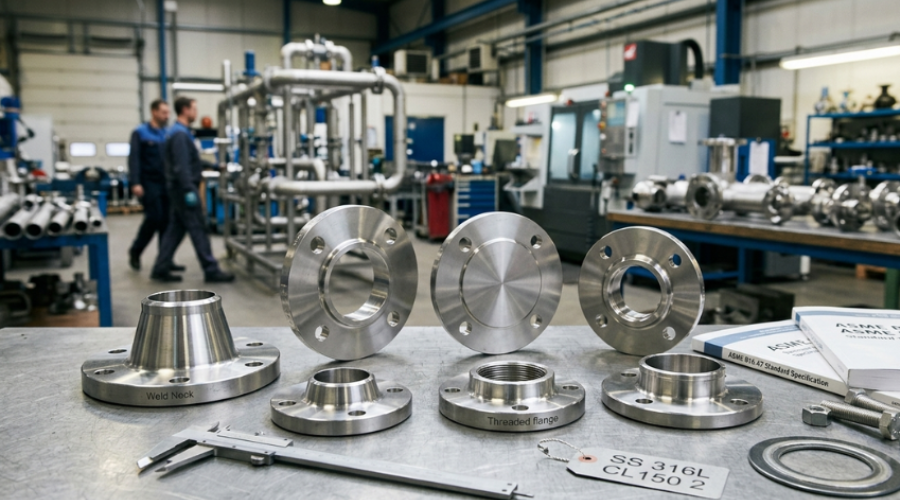
A flange is a flat, ring-shaped fitting used to join pipes, valves, pumps, or other equipment in a piping system. Instead of welding everything together permanently, flanges get bolted together with a gasket in between, creating a seal that can still be taken apart later for maintenance or inspection.
Stainless steel is the go-to material here because it resists corrosion, holds up at both high and low temperatures, and stays structurally sound under pressure. In industries where a failed joint means a chemical leak or a safety incident, that reliability isn't a nice-to-have it's the whole point.
Common Types of Stainless Steel Flanges
Flanges aren't built the same way across the board. Which one you need depends on pressure, pipe size, and how often the system needs to come apart.
Weld neck flanges have a tapered hub that's butt-welded to the pipe, giving a smooth transition that reduces stress at the joint. These show up most in high-pressure, high-temperature settings like oil & gas pipelines, where long-term reliability matters more than anything else.
Slip-on flanges slide over the pipe end and get welded on both the inside and outside. They're simpler to align during installation than weld neck flanges, which makes them a common choice for lower-pressure systems where ease of fabrication is the priority.
Socket weld flanges suit smaller, high-pressure piping. The pipe slots into a socket and gets welded on the outside only, leaving a smoother bore inside useful when you want to keep flow turbulence down.
Threaded flanges bolt onto pipe threads, no welding required. That makes them a practical option where welding would be risky or just impractical, though they're generally reserved for lower-pressure work.
Blind flanges are solid discs used to cap off the end of a line, valve, or pressure vessel opening. You'll see these used for system testing, future expansion points, or simply sealing off a section that isn't in use yet.
Lap joint flanges pair with a separate stub end and tend to show up in systems that need frequent disassembly food processing and pharmaceutical setups, for instance, where cleaning access matters.
Understanding Flange Standards and Ratings
This is the part that gets overlooked most often: making sure flanges actually meet recognized international standards. Two flanges can look nearly identical and still not be interchangeable if they were built to different regional specs.
ANSI/ASME standards — ASME B16.5 and B16.47 are the common ones are used widely across North America and in oil & gas projects worldwide. They define dimensions, pressure classes, and tolerances across a huge range of pipe sizes.
DIN and EN standards govern European-manufactured equipment, with dimensional and material requirements that don't always line up with ANSI specs.
JIS standards apply to flanges built for Japanese equipment and are common throughout parts of Asia.
On top of the dimensional standard, flanges carry a pressure class typically 150, 300, 600, 900, 1500, or 2500, measured in pounds. The higher the number, the more internal pressure the flange can handle. A flange that physically fits but carries the wrong pressure class is still a problem waiting to happen.
Material grade matters just as much. 304/304L is the standard choice for general corrosion resistance. 316/316L, with its added molybdenum, holds up better against pitting and crevice corrosion which is why it's the preferred grade for marine or coastal installations where chloride exposure is constant.
Matching Flange Type to Application
There's no single "best" flange just the right one for your specific conditions.
High-pressure, high-temperature pipelines in oil & gas or petrochemical work usually call for weld neck flanges, thanks to how well they distribute stress over the long run. For marine applications, where saltwater speeds up corrosion, 316-grade stainless is worth the extra cost over 304, no matter which flange type you go with.
Food and pharmaceutical processing tends to favor lap joint flanges with smooth-bore stub ends, since hygiene and easy disassembly are non-negotiable there. For lower-pressure utility lines, or anywhere welding poses a safety risk near flammable materials, say threaded flanges are a solid weld-free alternative.
Aerospace and precision manufacturing push tolerances and certifications to their limits, which is exactly why working with a supplier that can actually verify alloy composition through XRF testing, for example matters more in these sectors than almost anywhere else.
Why Quality and Certification Can't Be an Afterthought
A flange is only as good as the material and process behind it. A substandard one wrong alloy mix, off-spec tolerances, inadequate pressure testing can still pass a visual check and fail later, once it's actually under load.
That's the reason material test certificates, XRF verification, and ISO-certified processes matter so much when choosing a supplier. Assuming a flange "looks like" 316 stainless isn't good enough. Verified testing is the only way to actually know.
Final Thoughts
Stainless steel flanges sit right at the intersection of engineering and safety. Whether you're specifying parts for an oil & gas pipeline, a marine vessel, or a food processing line, getting the flange type, standard, pressure class, and material grade right is what separates decades of reliable service from an unplanned failure.
Platinum Metals Industries LLC supplies a full range of stainless steel flanges alongside pipes, tube fittings, and valves, backed by ISO certification, XRF testing, and more than 15 years serving clients across 30+ countries. If you've got a project that needs flanges, get in touch with our team to talk specs and request a quote.